
Plaster Stadium: A Home for the Bears

When Missouri State University's football team began playing in 1909, the sport was in its infancy: no professional league existed, inadequate protective gear contributed to serious injuries, and the forward pass had only recently begun to reshape the game. Over time, the sport grew in popularity, and in 1940, Missouri State built a 5,000-seat stadium. Later named for influential coach Arthur Briggs, the venue expanded through multiple renovations and eventually became Robert W. Plaster Stadium, a familiar landmark to generations of Missouri State athletes and alumni.
The Many Names of Missouri State
Throughout its long history, the institution of higher learning now known as Missouri State University has been renamed multiple times. For the sake of clarity, this article refers to the institution as “Missouri State University” or “Missouri State.” The timeline below lists the various names of the university as it evolved and grew alongside Springfield.
1905–1919: Fourth District Normal School
1919–1945: Southwest Missouri State Teachers College
1945–1972: Southwest Missouri State College
1972–2005: Southwest Missouri State University
2005 onward: Missouri State University
Arthur Briggs: A Visionary Coach
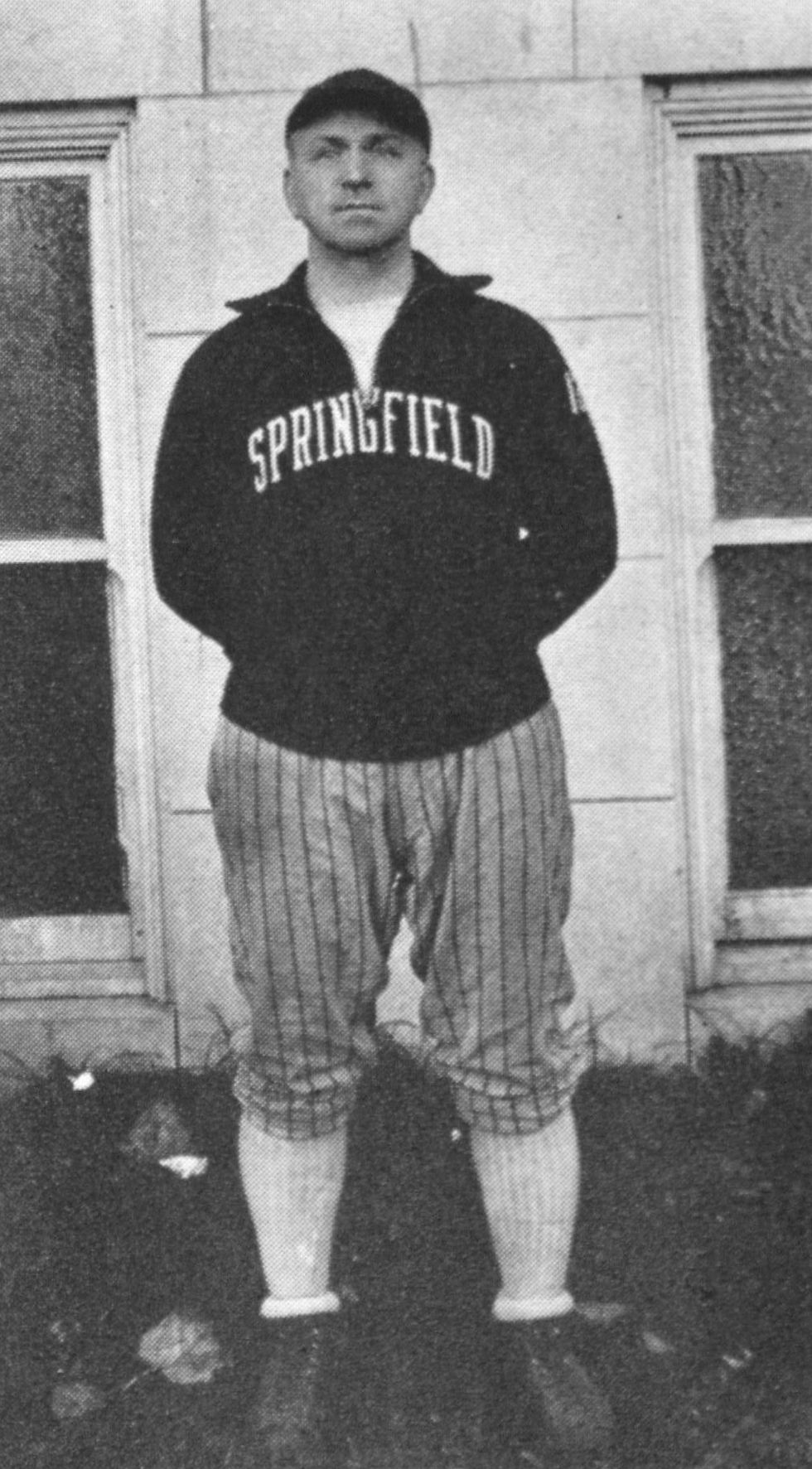
Arthur Briggs was one of the most influential figures in the early history of Missouri State University. When Briggs joined the faculty as the athletic director in 1912, the six-year-old campus had no arena or stadium to practice or play sports on. During his 37-year tenure with the university, Briggs taught physical education and coached the football, basketball, and track teams. His colleagues later credited him with single-handedly establishing the university’s athletic department.
Originally from Salem, Massachusetts, Briggs began playing football in 1904 at Springfield College in Massachusetts under Coach James H. McCurdy. Football was then primarily a running game, but McCurdy was one of several coaches at that time who were experimenting with a forward pass. The forward pass quickly evolved into an underhand spiral, and then into the revolutionary overhead spiral, allowing offenses to move the ball more effectively.
Briggs brought the lessons he learned in Massachusetts to Springfield, Missouri, and the Bears enjoyed tremendous success under his leadership. Former Missouri State Sports Information Director Mark Stillwell writes that Briggs “remained popular with his players” despite being a “stern and demanding taskmaster." Two of his teams went undefeated—first in 1914 and again in 1922, when the Bears outscored their opponents 308-18. Briggs stepped down after the 1933 season, concluding 20 years as head football coach with a 76-58-11 record.
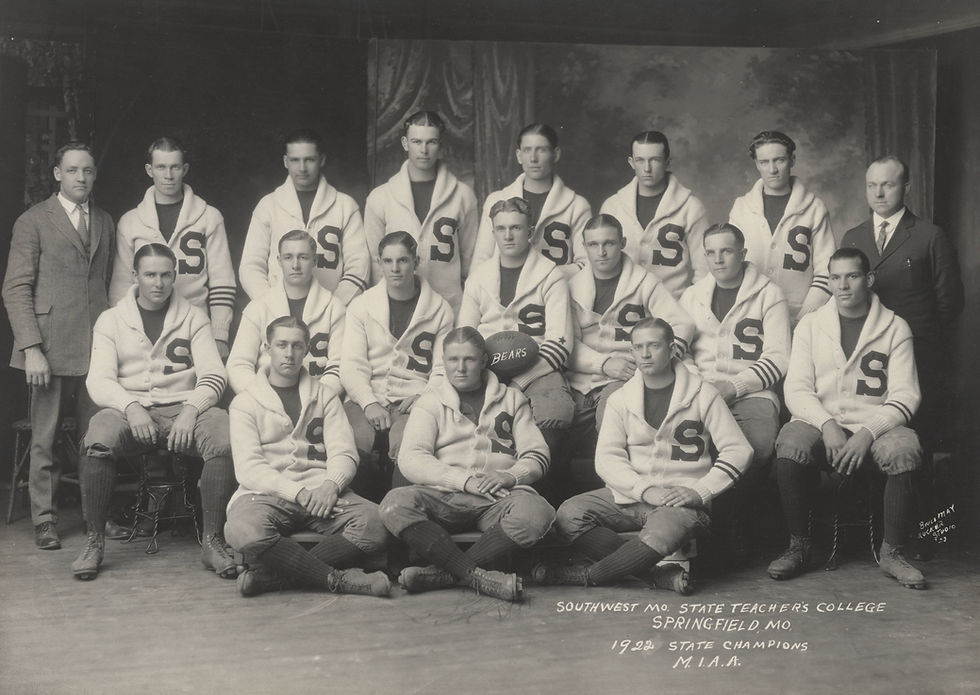
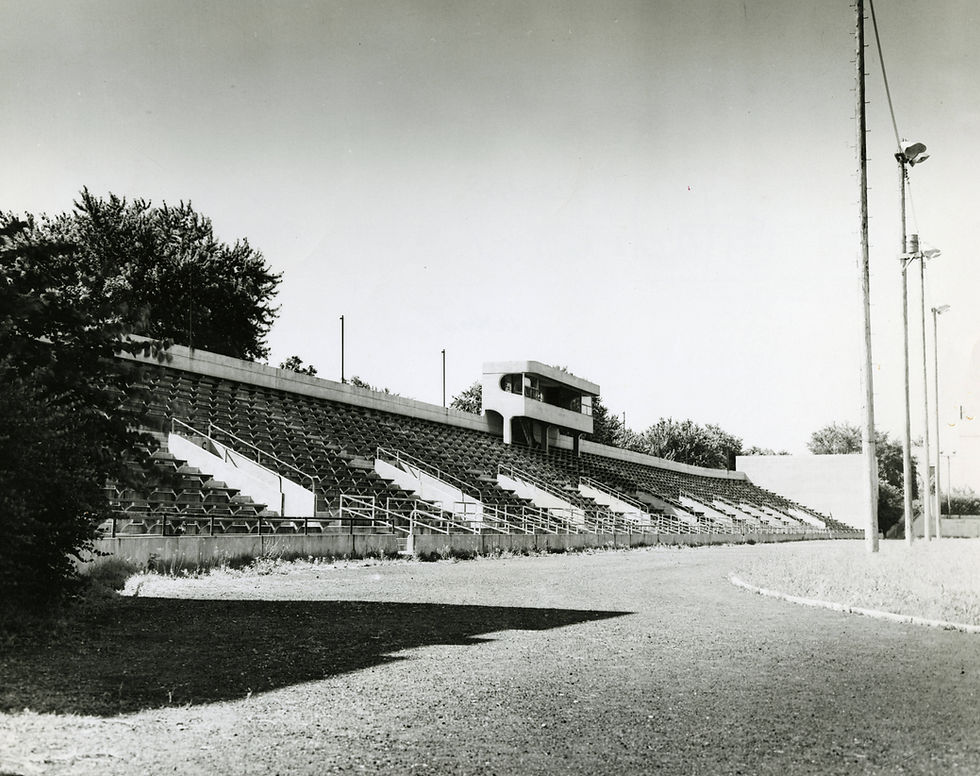
At first, Bears games drew small crowds and spectators sat on portable bleachers. By 1939, however, attendance was outgrowing the available seating, making the need for a permanent venue clear. In March 1940, the college received just over $65,500 from the Works Progress Administration to build a proper football stadium. Plans called for a 5,000-seat grandstand with a press box on the west side of the field. Anticipating continued growth, school officials planned to build an additional grandstand on the east side of the field "when attendance merits."
Construction began in April 1940, and in January the following year, the college received an added $14,496 from the WPA to construct sidewalks and iron fences at each end zone. The Bears played their first game in the new stadium on September 19, 1941. With a thirteen-game winning streak on the line, the Bears defeated the Southeastern State College Savages from Durant, Oklahoma, 46-0.
In 1970, the stadium was renamed after Arthur Briggs, honoring his career as a coach and educator whose vision for sports and physical education at Missouri State laid the foundation for the university’s future in athletics. For the next two decades, Briggs Stadium would serve as the Bears' football home.
From Briggs to Plaster
In 1988, university officials began a series of transformative upgrades to Briggs Stadium. Work began on the east side with the addition of 1,750 bleacher seats, along with restrooms and concession stands. The improvements increased east-side seating to about 4,500 and total stadium capacity to about 8,000. In fall 1989, the university planned another east-side expansion that would add 2,000 seats. Finally, in December 1990, the Board of Regents approved an ambitious $4.4 million plan that would more than double the stadium’s capacity while adding classrooms, racquetball courts, and a west-side upper deck with twenty-four skyboxes.
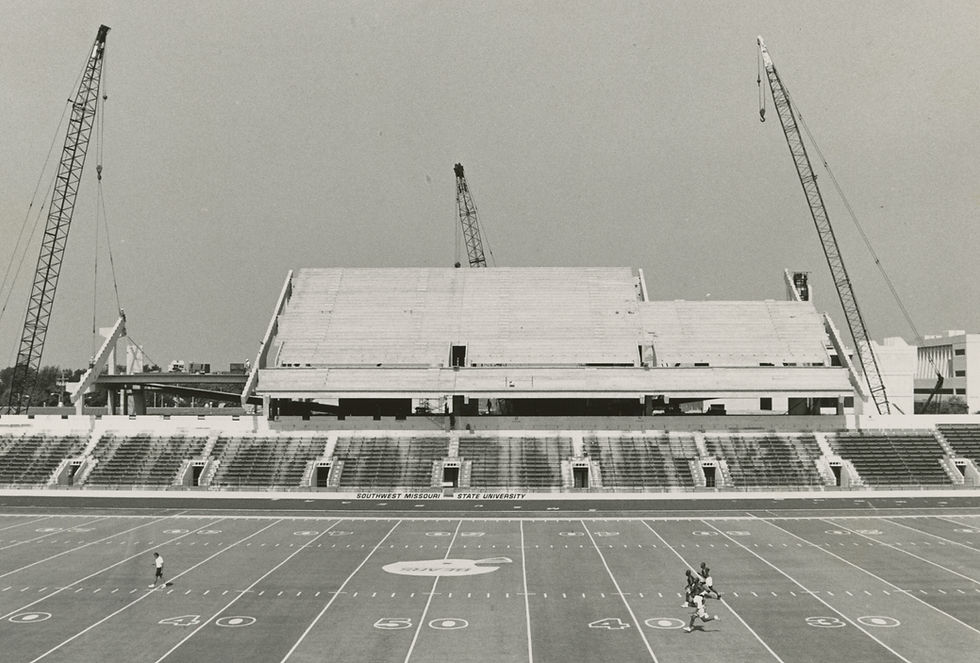
The massive project was funded by student fees previously allocated to operating Hammons Student Center, revenue from skybox sales, and a $3 surcharge on season tickets. “I don’t see the downside,” regent Jack Miller said. “I don’t see where we’re going to increase fees one penny. I don’t see where we’re going to ask the alumni to spend any more money than what they’re spending."
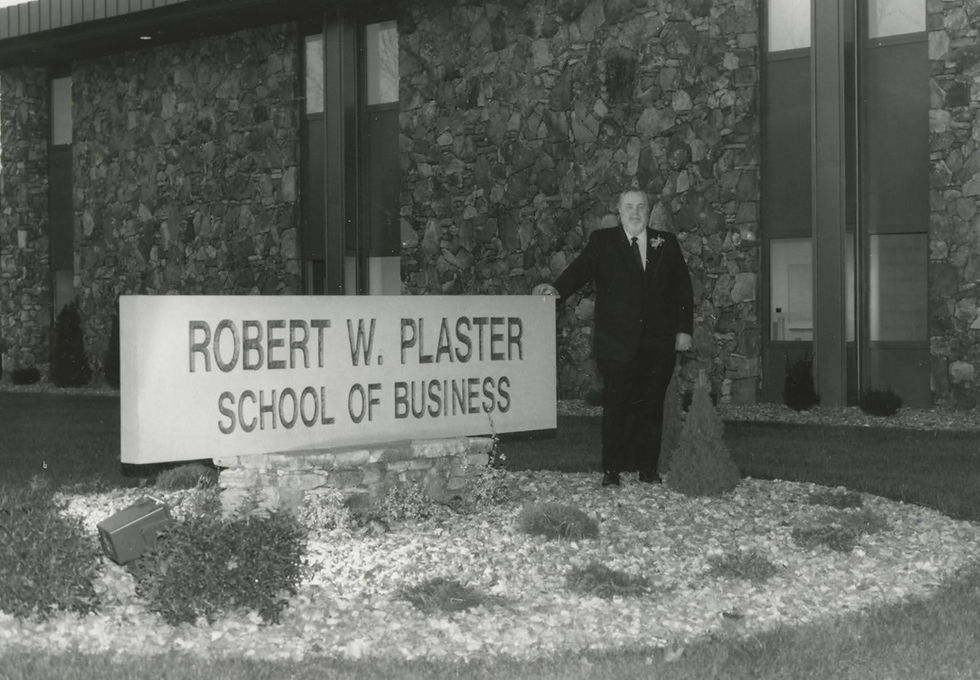
Despite the university’s projections, the funding sources fell short, and by July 1991, the construction project was running $520,000 over budget. The following month, the university’s Board of Regents voted to accept a $1.5 million gift from Lebanon businessman Robert W. Plaster to complete the seating and student recreation areas. In recognition of his contribution, the university named the expanded stadium and sports and recreation facility the Robert W. Plaster Sports Complex. University officials preserved Arthur Briggs’ legacy by renaming Belmont Street, immediately west of the stadium, Briggs Street, and establishing the $100,000 Arthur W. Briggs Award scholarship for football student-athletes.
The First Game
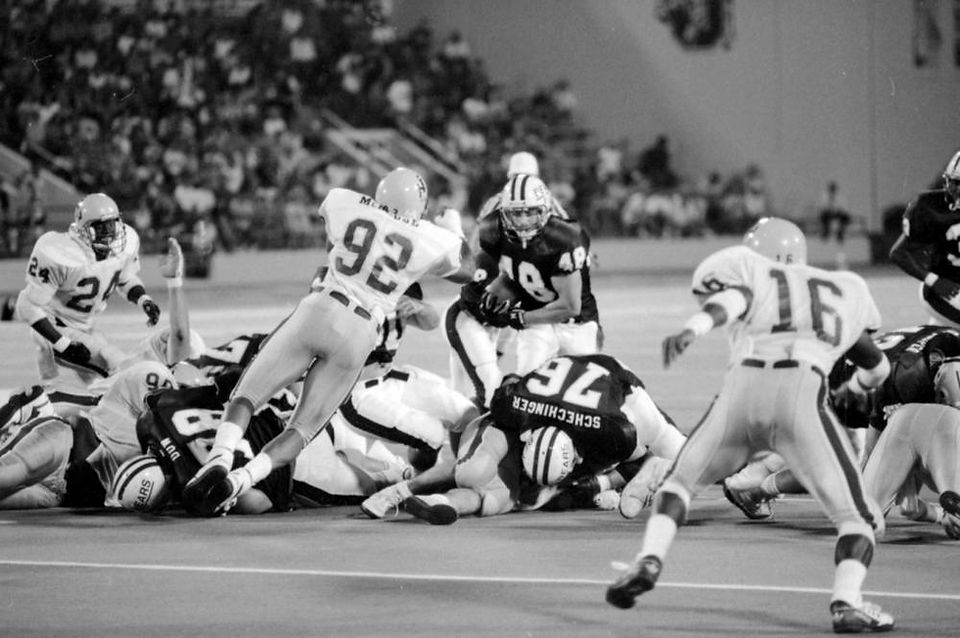
On September 14, 1991, the Bears faced Louisiana’s McNeese State University in the first game at the newly christened Robert W. Plaster Sports Complex. John Goodman, one of Missouri State’s best-known alumni, returned to campus for the occasion. Goodman, class of 1975, transferred to Missouri State to try to earn a spot on the football team, but his grades made him ineligible to play that season. He joined the drama department instead and later joked, “there were more girls in the theatre department than on the football team. It made it more inviting.” Goodman never returned to football, finding tremendous success as an actor instead. By 1991, he was a household name through his work in films and starring role in the popular sitcom Roseanne.
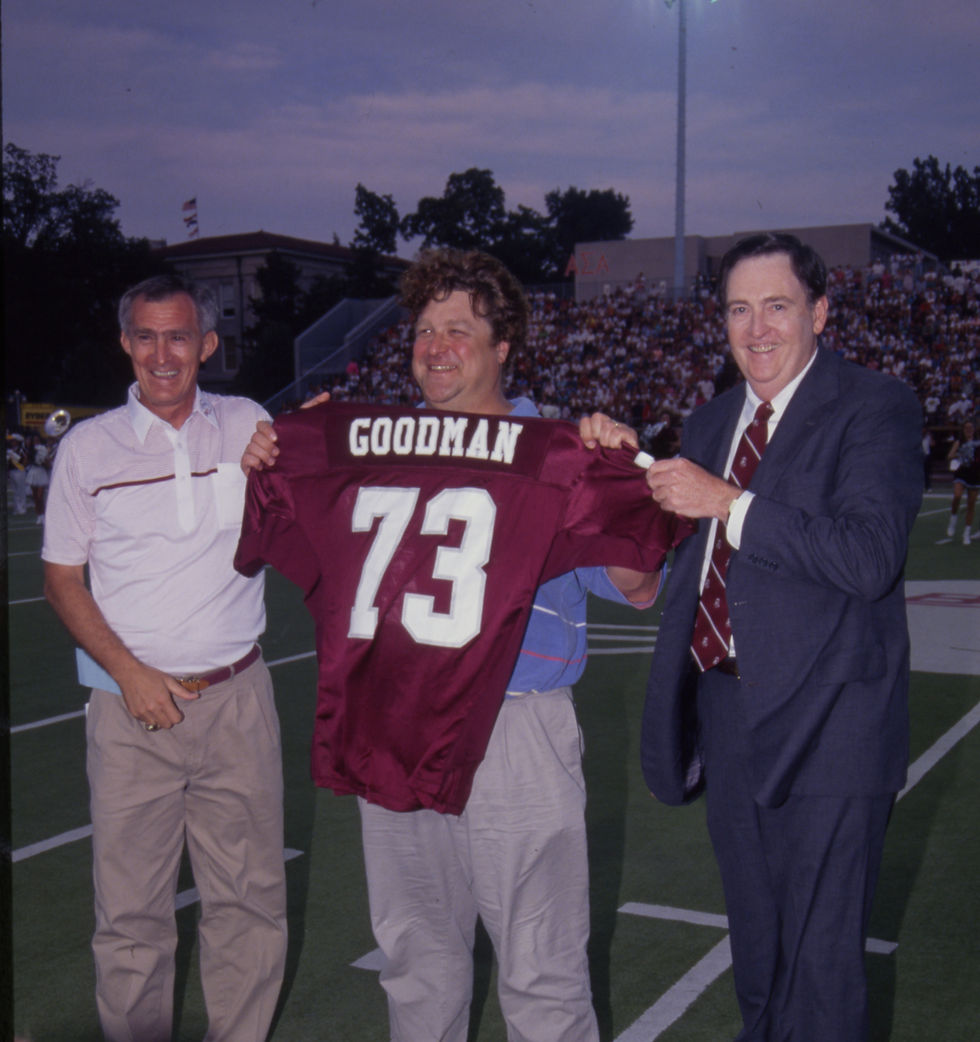
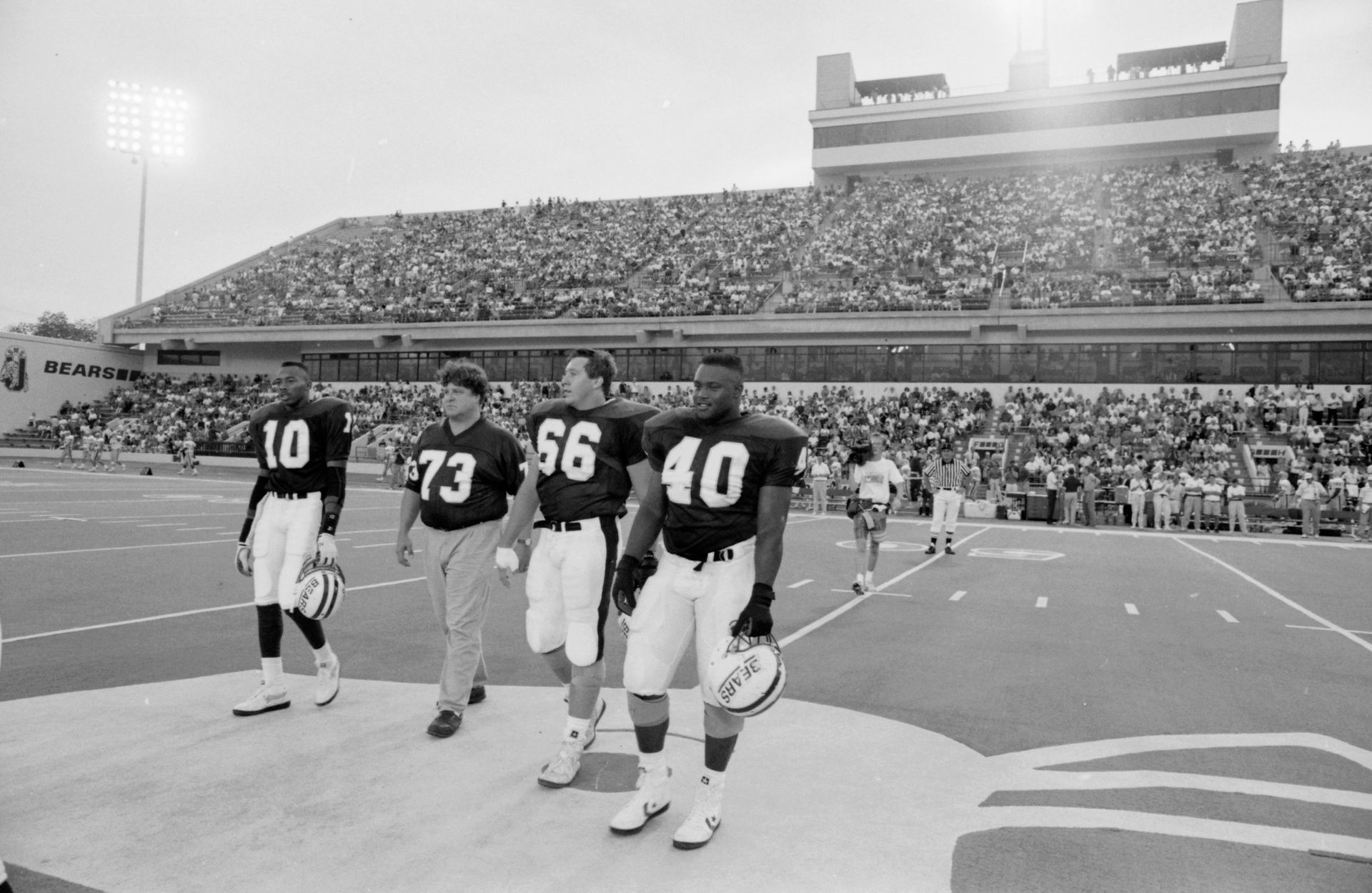
Goodman joined the Bears’ captains for the coin toss and received a football jersey from university president Marshall Gordon and athletic director Bill Rowe during a pregame ceremony. He did not keep it for long. After the game, Goodman parked his rented Cadillac outside the Sigma Phi Epsilon fraternity on Cherry Street and left the keys and jersey inside. The car was stolen early the next morning. Police later found the car abandoned near Lake Springfield, but the jersey was missing. Rowe promised to replace the jersey if it was not recovered.
A record-breaking 15,579 fans packed Plaster Stadium for the game, although Head Coach Jesse Branch admitted, “I think John Goodman helped draw a lot of the crowd tonight.” The Bears rewarded the crowd with a 7-3 victory powered by an outstanding defensive performance. In the final two minutes, the McNeese State Cowboys drove to the Bears’ 25-yard line, but the SMS defense kept them out of the end zone. “Our defense played a great football game,” Branch said afterward. “They had their backs to the wall and they did it.”
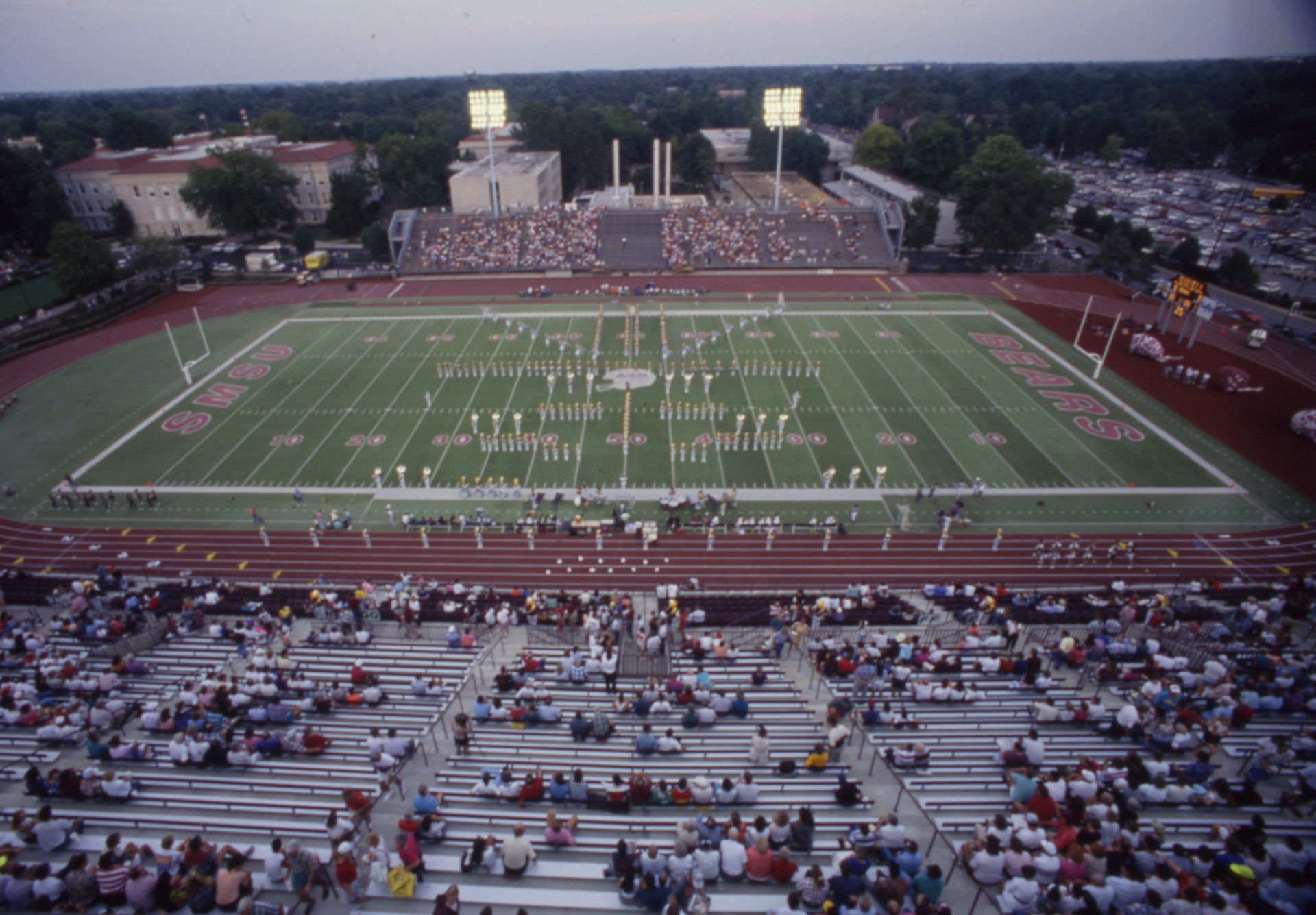
Photo by Mike Wingo. Springfield News-Leader Collection, Springfield-Greene County Library.
Amid the excitement of opening night at the Plaster Sports Complex, some fans protested the stadium’s new name. During the game, senior Dave Spurgin and other students displayed a banner reading, “FOR SALE. BRIGGS STADIUM. PLASTER REALTY.” Speaking to The News-Leader about the name change, Spurgin argued, “It ruins everything. I don’t think money should ruin tradition.”
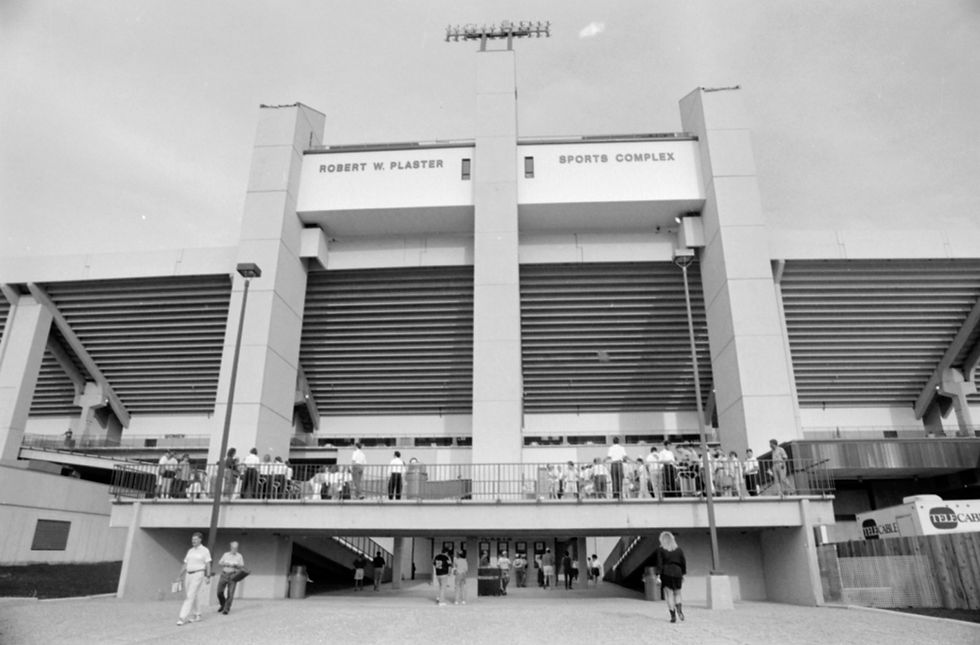
Steve Koehler, a sports columnist with The News-Leader, noted that it was hard to miss the words “ROBERT W. PLASTER SPORTS COMPLEX” spelled in metal letters high above the stadium entrance. Meanwhile, the new Briggs Street resembled a gravel driveway and was marked with a sign that, according to Koehler, looked as though it had been assembled “in the dark." Koehler also observed that Missouri State’s Plaster Stadium was not the first Plaster Stadium in the Ozarks. The Southwest Baptist University Bearcats played in the first Robert W. Plaster Stadium in Bolivar, less than an hour away from Missouri State.
Members of the Briggs family also voiced their displeasure over the name change. Speaking with The Southwest Standard, Missouri State’s student newspaper, Arthur Briggs’ grandson, Tom, said that while his family did not “want to stand in the way of progress at the university,” he believed that “making changes for the sake of money dishonors the people who put it in the place it is today."
Other members of the campus community saw the name change as proper recognition of Plaster’s donation. “Plaster saved the stadium money from coming from the students’ pockets,” said Art Rainey, president of student advocates at Missouri State. “They don’t understand that."
Plaster Today—and Tomorrow
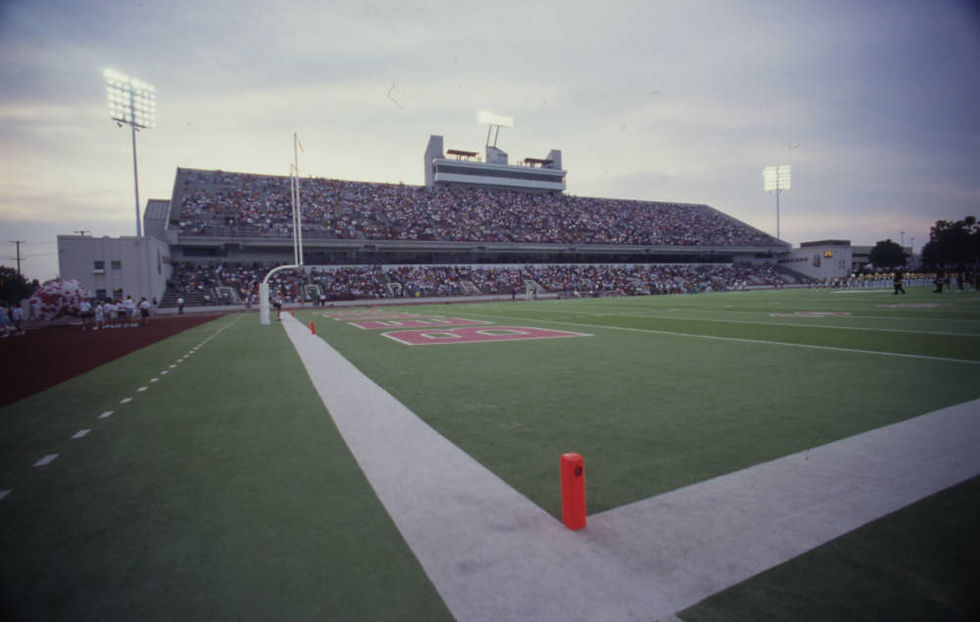
Plaster Stadium’s west grandstand received further upgrades ahead of the 2014 season. Waterproofing was the highest priority, as leaks had already caused damage to the structure. Improvements were also made to make the facility more accessible to people with disabilities.
With these renovations came the facility’s most recent name change. University officials had decided that Plaster would now be used solely for football, allowing them to officially shorten “Robert W. Plaster Sports Complex” to “Robert W. Plaster Stadium." This change necessitated new signage, which pleased university president Clif Smart, who had noted that paint had started to drip from the “Robert W. Plaster Sports Complex” sign, staining the wall beneath and causing the stadium’s entrance to look, according to Smart, “embarrassingly horrible." The signage was replaced by two panels mounted on the west side of the grandstand: one reading “Robert W. Plaster Stadium,” while the other depicts the iconic Missouri State University appearing to peek through the panel. “I really like the peeking bear,” said an approving Smart. “I think that’s one of our best visuals."
In May 2024, Missouri State announced that it would join Conference USA and begin competing in the Football Bowl Subdivision in the 2025 season. The move made the Bears eligible for postseason bowl competition in games such as the Rose Bowl or Orange Bowl. University President Richard “Biff” Williams estimated that Plaster Stadium would need substantial upgrades, costing around $100 million, before the program and venue could support competition at that level. Williams acknowledged that fundraising and construction would take several years, giving Bears fans many improvements to look forward to in the coming season.
From its beginnings as a Works Progress Administration project to its potential as a modern Division I venue, Plaster Stadium reflects the growth of Missouri State athletics and the changing priorities of the university. Its successive names preserve the legacies of Coach Arthur Briggs and Robert W. Plaster, and future renovations will add another chapter to the story of the stadium that has served generations of Bears.
If you enjoyed this article, please consider making a donation to the Preserving Ozarks History Endowment. Each contribution supports Local History & Genealogy's mission of preserving the history and culture of the Ozarks.
Want more local history news and stories delivered directly to your inbox? Sign up for Local History & Genealogy's newsletter and email announcements.
References
Bauer, Traci. "Grandsons say university sells out." The Southwest Standard, 30 August 1991, p. 1.
Clark, Christopher. "Stadium renamed Plaster Field." The News-Leader, 14 August 1991, p. 1.
Edwards, Robert. "Briggs Stadium over budget." The News-Leader, 20 July 1991, pp. 1B-2B.
—. "Regents OK plan to enlarge stadium." The News-Leader, 22 December 1990, pp. 1A; 7A.
—. "SMS stadium to seat 9,000 by fall of 1990." The News-Leader, 18 November 1989, pp. 1A; 8A.
"Fences Removed as Work Begins on New Stadium." Springfield Daily News, 16 April 1940, p. 7.
"Hapless Savage Tribe Crushed By STC Merry-Magicians, 46-0." Springfield Daily News, 20 September 1941, p. 9.
Hazelrigg, Larry S. "Bears enjoy new home." The News-Leader, 15 September 1991, p. 1D.
—. "Bears have blast at new Plaster Field." The News-Leader, 15 September 1991, p. 6D.
"Heart Attack Claims Coach A. W. Briggs." Springfield Leader and Press, 20 December 1949, pp. 1-2.
Koehler, Steve. "Goodman finally to get jersey." The News-Leader, 13 September 1991, p. 1A.
—. "SMS boots a legend into street." The News-Leader, 15 August 1991, p. 1E.
—. "Some fans still upset about name." The News-Leader, 15 September 1991, p. 1D.
"Largest SMS crowd sees win." The News-Leader, 15 September 1991, p. 1A.
Lemons, Terry. "Regents back work at stadium." The Springfield News-Leader, 6 August 1988, pp. 1A; 10A.
—. "SMS views new facelift for stadium." The Springfield News-Leader, 20 July 1988, pp. 1B-2B.
Missouri State University. "History of the University." 28 July 2026. Missouri State University. Accessed 27 August 2026.
"No. 73 missing." The News-Leader, 17 September 1991, p. 1A.
"Okeh Teachers' College Football Stadium, WPA Chief Expects Work To Start April 1." Springfield Daily News, 13 March 1940, p. 9.
Pokin, Steve. "MSU to replace 'embarrassingly horrible' sign." Springfield News-Leader, 17 April 2014, p. 4A.
Riley, Claudette. "Goodman on MSU homecoming, Tent Theatre." Springfield News-Leader, 31 October 2022, p. 4A.
Smith, Perry. "The Bench Warmer." Springfield Leader and Press, 22 December 1949, p. 19.
"STC to Uncork Fancy Offense in Season Bow." Springfield Leader and Press, 19 September 1941, p. 8.
Stillwell, Mark. "The Legacy of Arthur W. Briggs." Landon, Donald D. Daring to Excel: The First 100 Years of Southwest Missouri State University. Marceline, Mo.: Walsworth Publishing Company, 2004, p. 92.
Temple, Christine. "MSU sign: From 'embarrassingly horrible' to 'fabulous' in months." Springfield News-Leader, 13 August 2014, p. 5A.
Wheeler, Wyatt D. "FAQ: What it means as Bears move to C-USA." Springfield News-Leader, 12 May 2024, pp. 1B-2B.
—. "Missouri State set to join Conference USA." Springfield News-Leader, 12 May 2024, pp. 1B-2B.
—. "MSU AD on Plaster Stadium future, football financials." Springfield News-Leader, 3 September 2024, pp. 1B; 3B.
"WPA Approves New Football Stadium Here." Springfield Leader and Press, 12 March 1940, p. 1.
"WPA Okehs $14,496 Project To Finish STC Grid Stadium." Sunday News and Leader, 26 January 1941, p. A12.