
Mickey Mantle: A Yankees Legend in Springfield

Updated: Apr 25
Springfield, Missouri has a rich baseball history, and while many celebrated players have graced local diamonds, few have been better known than Mickey Mantle, one of the greatest players in New York Yankees history. Before being recruited by the Yankees, however, Mantle played in the Ozarks, facing off against the Springfield Cubs in 1950. Three years later, he chose to have knee surgery at Burge Hospital in Springfield following a string of injuries. Then, long after his playing days were over, Mantle appeared at a local grocery store to promote his memoir.
The Scout in the Cadillac
Mickey Mantle grew up in Commerce, Oklahoma, about 100 miles from Springfield. In the summer of 1948, he was a junior in high school and playing for a semi-pro team, the Whiz Kids. It was at their small park in Baxter Springs, Kansas where New York Yankees scout Tom Greenwade first saw Mantle play. Born in Willard, Missouri, Greenwade traveled throughout the region looking for the next great baseball player, making his rounds in a new Cadillac. The two barely spoke that season, as Mantle was too young to be recruited by professional teams, but Greenwade promised he would return the next year.

Jane Leavy’s biography, The Last Boy: Mickey Mantle and the End of America’s Childhood, describes two versions of Greenwade’s assessment after seeing Mantle in action. Speaking to Mantle's father, Greenwade warned that he was a “marginal prospect. Might make it, might not. Kind of small. Not a major league shortstop.” As Mantle became one of the best players in baseball history, Greenwade bragged, “The first time I saw Mantle I knew how Paul Krichell felt when he first saw Lou Gehrig.” Mantle thought no other teams were interested in him, and he accepted Greenwade’s modest terms of $140 a month plus a $1,150 signing bonus.
Mantle was assigned to the Class D Independence Yankees, where he played 89 games during the 1949 season. Springfield native Jack Hasten was Mantle’s roommate that year. “He was a very quiet kid, an easy-going type of guy,” Hasten recalled. “I liked him immediately.” Mantle played shortstop and had a hard time adjusting to professional baseball, committing 55 errors and having difficulty making contact early in the season. Doubt crept in, and Mantle considered quitting, but his father reminded him, “You can come on home with me and work in the mines.” By the end of the season, Mantle had an excellent .313 batting average.
The Joplin Miners
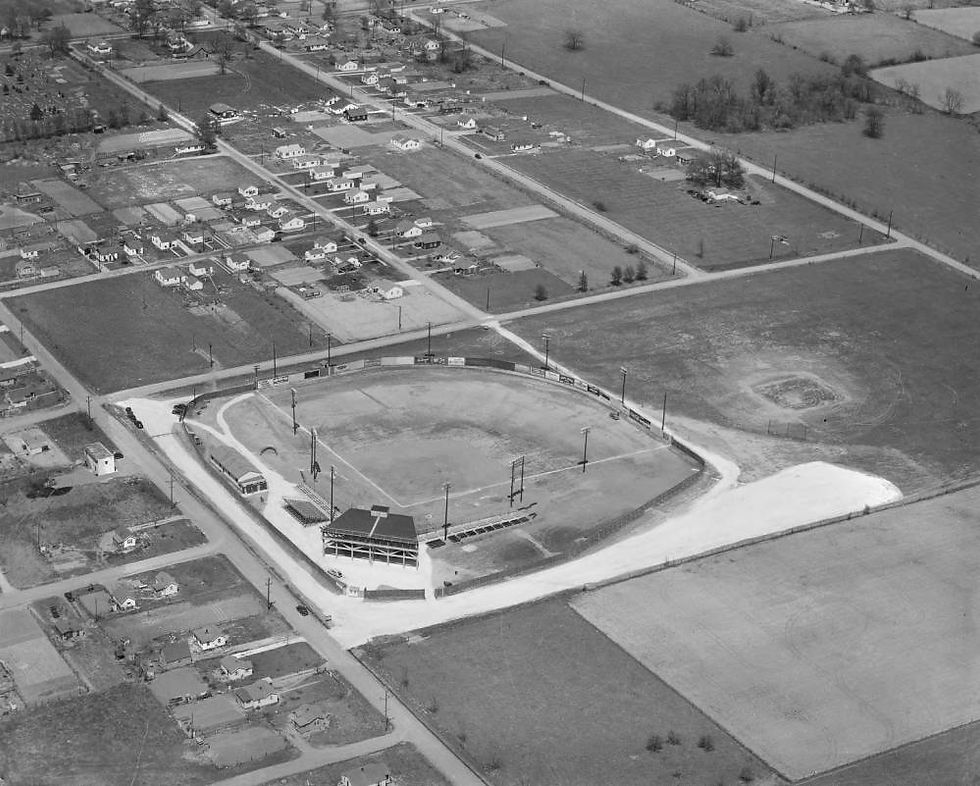
In 1950, Mantle was promoted to the Joplin Miners, a Class C team in the Western Association. That season, Springfield’s professional baseball team was an affiliate of the Chicago Cubs. The Cubs had recently relocated their struggling minor league franchise from Hutchinson, Kansas to Springfield, loaning local promoters $25,000 in the spring of 1948 to complete work on their venue, Memorial Stadium, at the corner of West Avenue and Madison Street. With both the Springfield Cubs and the Joplin Miners in the Western Association, the two teams were division rivals. As a result, Mantle played in Springfield several times that season.

Mantle’s first game in Springfield, on April 24, 1950, was an eventful one. It was the Cubs’ home opener, played on a chilly night with strong winds swirling around the stadium. Local weatherman C. C. Williford threw out the first pitch to Mayor O. L. Barbarick, who lost his glasses and missed the ball—which hit the umpire.
Just over 2,300 fans saw this mishap, but few were left when floodlights went dark along the right field line in the bottom of the eighth inning. By that time, Mantle had gotten two hits and scored one run, but the Cubs were leading 6-5. The game was resumed two nights later after an hour delay, again caused by malfunctioning floodlights. The Cubs held on to their lead and won the game, but the Miners won the final game of the series 7-1, with Mantle getting one hit and scoring two runs. Mantle’s most memorable game in Springfield was on June 21, when he hit a 390-foot home run over the right field wall—a Memorial Stadium record at the time—although the Miners still lost 5-4.

The Miners won the 1950 regular season Western Association championship and faced the Cubs in the playoffs. The teams split the first two games of the best-of-three series, and the deciding game was played in Springfield on September 9. Mantle had one hit and scored two runs, but it was not enough as the Cubs won 10-9 in ten innings. That game was his last with the Joplin Miners.
With the most hits, runs scored, and the highest batting average in the association at .384, Mantle won the 1950 Western Association batting championship. Although he was a top prospect in the Yankees organization, Porter Wittich of the Joplin Globe did not expect to see Mantle wearing pinstripes soon. “So a first-string major league job is not for Mickey next year, nor maybe the next, nor even an infield post when he gets there, which he certainly should.” Wittich predicted that “along about 1954—or before—maybe we will be reading about him in the Yankee lineup.”
The World Series Injury
Joplin fans did read about Mantle and his exploits with the Yankees—in 1951, not 1954. Recognizing his strong arm, the Yankees moved Mantle to center field. While he made the opening day roster on the strength of his hitting, his defense improved under the Yankees’ tutelage. However, Mantle was just nineteen years old, and, like many rookies, he struggled at times against big-league pitching. In July, he was sent to the Kansas City Blues to gain more experience at the plate; he was recalled to the Yankees on August 20.
Mantle’s career changed dramatically on October 5, 1951, in Game 2 of the World Series at Yankee Stadium. Willie Mays hit a long fly ball in the fifth inning, and Mantle ran toward it. At the last moment, though, Joe DiMaggio called him off. Mantle stopped abruptly to avoid a collision and collapsed with an injury to his right knee.

After the game, he told reporters, “I don’t know what happened. I never had any trouble with the leg before. I was running and suddenly something popped in the knee.” It was later determined that one of his cleats had probably caught on a drain cover. Mantle was diagnosed with a slightly torn tendon and did not play in the rest of the 1951 World Series, which the Yankees won four games to two.
Mantle returned to the Yankees lineup in 1952 but hurt his knee again, and once more the following year. Playing with it heavily bandaged, the injury took a toll on his greatest strengths: his speed and his ability to hit from both sides of the plate. His performance from the left side suffered, and his batting average fell from .311 in 1952 to .295 in 1953. Doctors at Johns Hopkins in Baltimore recommended surgery to remove torn cartilage, but at just twenty-two years old, Mantle was reluctant to go under the knife.

The prospect of recovering in a hospital on the East Coast concerned Mantle. He was shy and uncomfortable with his fame, and his three-week stint at Lenox Hill Hospital in New York following the World Series injury had been a miserable experience, with a steady stream of visitors ignoring his requests for privacy. Yankees General Manager George Weiss referred Mantle to his friend, Dr. Bertram Meyer, of Springfield, Missouri. Dr. Meyer and Dr. Daniel Yancey, a well-known orthopedist at Burge Hospital, confirmed the original diagnosis.
Mantle at Burge

Mantle agreed to the surgery and checked into Burge Hospital on November 1, 1953. He was accompanied by Tom Greenwade, who told reporters, “We want Mickey’s recovery to be as rapid as possible and we feel he will recuperate better if visitors are limited to his family.” The next day, Dr. Yancey, assisted by Drs. Meyer and Frank Sundstrom, performed the operation in 45 minutes.
The cartilage was shriveled at one end, as expected, but the doctors were surprised to find it split and separated on the other end—likely the result of the 1953 injury. Dr. Yancey believed the removed cartilage had acted as a “shock absorber to the knee joint,” but that its function would now be taken over by the growth of fibrous tissue. “The main ligaments in the knee weren’t affected,” the surgeon told reporters.
Dr. Yancey prescribed a strict three-month rehabilitation process, which he said would be as important as the surgery itself. Unfortunately, Mantle’s knee had been damaged beyond full repair, and an estimated five percent of its range of motion could not be restored. After the surgery, Mantle confided in Dr. Yancey that his knee had hurt more than he had let on.

Although visitors were kept to a minimum at his request, Mantle was reminded of how competitive professional baseball could be during his time at Burge. Mrs. Corine Andrews was one of the nurses on Mantle’s floor, and her brother, Bill Virdon, stopped by to wish Mantle well. The visit created an awkward situation: Virdon was a player in the Yankees organization who had been invited to spring training with the big league club. As an outfielder, he was expected to compete with Mantle for a starting position on the Yankees roster. Mantle returned to center field when the 1954 season started. Virdon eventually made it to the Major Leagues, joining the St. Louis Cardinals in 1955.
Back at Yankee Stadium
While Mantle returned to the Yankees as scheduled and retained much of his speed, he was not the same player. The injury had affected his lateral motion, and the state of medicine in 1953 prevented Dr. Yancey and his team from fully understanding the extent of the damage. Mantle’s knees steadily deteriorated, causing him pain throughout the rest of his life.

A modern analysis by Dr. Stephen Haas, included in Leavy’s The Last Boy, concluded that “the most likely critical event was an acute combination of torn medial collateral and anterior cruciate ligaments and a medial meniscal tear.” That Mantle played another fourteen seasons for the Yankees was, by Haas’s estimation, only possible because Mantle was a “neuromuscular genius”—“one of a select few who are so well wired that they are able to compensate for severe injuries like this and still perform at the highest levels.” Mantle’s post-surgery performance was, according to Haas, “a phenomenon comprised of motivation, high pain threshold, strength, reflexes, and luck.”
Mantle retired after the 1968 season, but remained close to the game. In the 1980s, he appeared as an analyst on Yankees television broadcasts, covering 25 games a year. In this role, Mantle questioned the practice of giving young players long-term contracts. “I think you should earn what you make and get paid by the year like we used to do,” Mantle argued. “I just wonder if I would have had a 20-year contract for $2 million a year, if I would have played in a lot of the games I did play in.”
The Mick Visits Springfield
Mantle returned to Springfield on September 18, 1986 for an autograph session promoting his memoir, The Mick. He greeted over 2,000 fans, many of whom were too young to have seen him play, at the Dillons grocery store on National Avenue and St. Louis Street. Mantle never tired of signing autographs. “It’s flattering,” he said. “What if nobody even knew you? It’d be a lot worse.”

While in Springfield, Mantle sat down for an interview with KY3 Sports Director Ned Reynolds. The two discussed Mantle's career, Yankees coaching and management, and substance abuse in Major League Baseball. View the full interview below:
The Legacy of the Commerce Comet
During his career, Mantle hit a record 18 home runs in the World Series, was named to the All-Star team 20 times, won a Gold Glove for his play in center field, and retired with a .298 batting average. He was inducted into the National Baseball Hall of Fame in 1974.
Mantle’s legend has only grown since his playing days, sustained in part by the enduring value of his 1952 Topps baseball card. “I can remember when my kids were little, they used to run around and play with those cards all the time,” Mantle recalled. “Topps would send us big boxes of them and our kids would give them to kids around the neighborhood. We don’t have any of them left.” Valued at $3,000 in 1986, one card in mint condition sold for a record-shattering $12.6 million in 2022.
Mantle passed away in Dallas on August 13, 1995. His first professional teammate, Jack Hasten, spoke for many when he said, “I feel a sense of loss because of what he meant to so many different people. We don’t have too many heroes anymore. We need another Mickey Mantle to come forward.”
If you enjoyed this article, please consider making a donation to the Preserving Ozarks History Endowment. Each contribution supports Local History & Genealogy's mission of preserving the history and culture of the Ozarks.
Want more local history news and stories delivered directly to your inbox? Sign up for Local History & Genealogy's newsletter and email announcements.
Note
The photograph of Mickey Mantle playing for the Joplin Miners is the property of the Joplin Historical Society. It may not be used or copied without written permission from the Joplin Historical Society.
Acknowledgements
Special thanks to:
Ned Reynolds for providing the footage of his interview with Mickey Mantle and to KY3 for hosting the video of the interview
The Joplin Historical Society for use of the photograph of Mantle playing for the Joplin Miners
Resources
Associated Press. "Yanks Recall Mickey Mantle." The Kingston Daily Freeman, 21 Aug. 1951, p. 13.
"Bill Virdon." Baseball-Reference.Com. Accessed 29 Mar. 2026.
Brasel, Kenny L. "Pinch Hitting." Springfield Leader and Press, 3 Nov. 1953, p. 13.
Calvan, Bobby Caina. "Sports Memorabilia Soars in Value." Springfield News-Leader, 29 Aug. 2022, p. 4B.
"Cubs Edge Joplin, 10-9, to Bag Series." Sunday News and Leader, 10 Sept. 1950, p. C-1.
International News Service. "Mantle to Undergo Knife Here Monday." Springfield Daily News, 30 Oct. 1953, p. 25.
"Ironical Situation Develops at Burge." Springfield Daily News, 2 Nov. 1953, p. 5.
"Joplin Miners, Champions of the Western Association." Joplin Globe, 3 Sept. 1950, p. 1C.
Leavy, Jane. The Last Boy: Mickey Mantle and the End of America's Childhood. Harper, 2010.
"Lighting Failure Leaves Cubs' Victory in Doubt." Springfield Daily News, 25 Apr. 1950, p. 9.
"Mantle Comes Through Surgery in Top Shape." Springfield Daily News, 3 Nov. 1953, p. 9.
"Mantle, Mickey." National Baseball Hall of Fame. Accessed 29 Mar. 2026.
"Mantle Wallops at .384 Clip, Wins Honors in Four Divisions." Sunday News and Leader, 10 Sept. 1950, p. C-3.
"Mickey Mantle." Baseball-Reference.Com. Accessed 29 Mar. 2026.
"Mickey Mantle - Legend." Mickey Mantle, 2026.
"Mickey Mantle Begins Recuperation Period." Springfield Daily News, 4 Nov. 1953, p. 13.
"Mickey to Kansas City." Joplin Globe, 17 July 1951, p. 10.
"Outfielders Swap Tales." Springfield Daily News, 12 Nov. 1953, p. 13.
Puryear, Scott. "The Mick: Playing for Time." The Springfield News-Leader, 21 Sept. 1986, p. 6F.
Skalicky, Francis. "First Teammates Recall Shy, Happy Shortstop." Springfield News-Leader, 14 Aug. 1995, p. 4C.
Smith, Perry E. "Bench Warmer." Sunday News and Leader, 20 June 1948, p. C-1.
"Springfield Maintains Lead Beating Joplin, 5-4." Springfield Daily News, 22 June 1950, p. 13.
"Springfield Wins Delayed Game, Loses Second." Springfield Daily News, 27 Apr. 1950, p. 13.
"Surgery to Fix Mantle's Knee Is Performed." Springfield Leader and Press, 2 Nov. 1953, p. 13.
United Press. "Mantle Frets Over Bad Knee." Springfield Leader and Press, 6 Oct. 1951, p. 3.
Wittich, Porter. "Globe Trotter." Joplin Globe, 21 Sept. 1950, p. 4B.
Further Reading
Aton, Rusty D. Baseball in Springfield. Arcadia, 2005.
Hand, Jack. "Series Activity Shifted to Polo Grounds." Springfield Leader and Press, 6 Oct. 1951, p. 3.
Holmes, Tommy. "Scatter Shot at The Sport Scene." Brooklyn Eagle, 16 July 1951, p. 11.