

The Mystery of the Electric Pencil

Content Warning: This article discusses suicide and mental illness.
In May 2007, Sony Hocklander of the Springfield News-Leader introduced readers to the artist known as the Electric Pencil. Harris Diamant, an artist and art dealer from New York, had contacted the News-Leader for help identifying the artist behind one of his recent purchases: an album of over two hundred drawings, carefully rendered in pencil and crayon. Many pages bore the letterhead of State Hospital No. 3, also known as State Lunatic Asylum No. 3, formerly located in Nevada, Missouri. Pre-printed dates on the pages read "189_", "190_", and "191_".
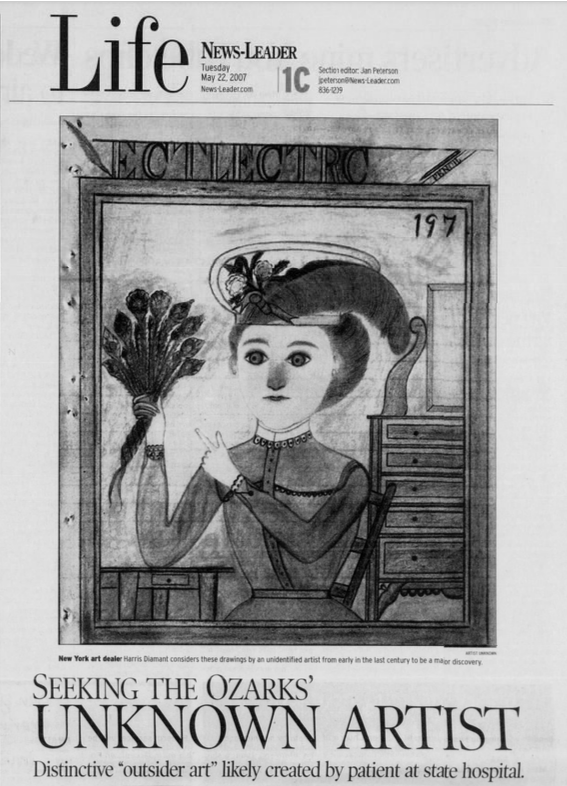
Diamant took the nickname "Electric Pencil" from drawing 197, which features a small, captioned rendition of a pencil and letters spelling "ECTLECTRC," perhaps a fanciful spelling of the word "electric."
"If you recognize... the drawings," wrote Hocklander, "or if you think you might be related to the artist—let me know. Your tip might solve an artist mystery."
According to writer Richard Goodman's introduction to The Electric Pencil: Drawings From Inside State Hospital No. 3, the Electric Pencil first became an art world sensation when images from the album were published online in 2006. Soon after, the album began circulating among folk art collectors and enthusiasts across Missouri. After tracking down and purchasing the album, Diamant set to work unraveling the mystery of the Electric Pencil.
An Album in the Trash Heap
The Electric Pencil's work reaches us today through a chance discovery. In 1970, a fourteen-year-old boy noticed the handmade cover of the album in a pile of garbage on Seminole Street, in Springfield, Missouri's Brentwood neighborhood.
The album contained 283 drawings, most of them numbered, with subjects including finely dressed people, vehicles such as hot air balloons and steamboats, animals, buildings, and pastoral nature scenes. Portraits feature large eyes, small mouths, and smudgily rendered noses, and subjects' clothing is meticulously detailed with lace trimming and pintucks. The images are striking, and the quantity astonishing.
Electric Pencil drawing 197. Published in The Drawings of the Electric Pencil. Electric Pencil drawing 199. Published in The Drawings of the Electric Pencil. Electric Pencil drawing 255. Published in The Drawings of the Electric Pencil. Electric Pencil drawing 127. Published in The Drawings of the Electric Pencil. Electric Pencil drawing 207. Published in The Drawings of the Electric Pencil.
The boy held on to the album for thirty-six years. Then, in 2006, he contacted Lyndon Irwin, a Vernon County historian, about selling the book. Irwin posted images of some of the Electric Pencil's drawings on his website. The artwork quickly drew the attention of collectors and dealers across the art world, since "outsider art" and especially works created by mental health patients were highly sought after. In 2010, the drawings were published in a hardcover volume titled The Drawings of the Electric Pencil.
What is outsider art?
Outsider art, or art brut, refers to artistic works made with little influence from mainstream culture. "Outsider art emphasizes the reason that the artist is making it rather thant he qualities that are inherent in it," said Drury University professor Tom Parker in an interview with News-Leader staff writer Juliana Goodwin. "The logical progression of art culture is of no concern to them. It bypasses or rejects the art establishment."
The Electric Pencil captured imaginations and raised questions: Who was the artist? When were the drawings made, and why? Was he really a patient of State Hospital No. 3?
Art as Medicine in State Hospital No. 3
State Hospital No. 3 was built in 1887 in Nevada, Missouri in accordance with the specifications of Thomas Kirkbride, a Pennsylvania doctor described by Goodman as "a determined advocate for the humane treatment of the mentally ill." Unlike many of his contemporaries, Kirkbride prioritized kindness and respect. "I know of no reason why an individual who has the misfortune to become insane, should, on that account, be deprived of any comfort or even luxury, that is not improper or injurious," he wrote in his 1854 book, On the Construction, Organization, and General Arrangements of Hospitals for the Insane, quoted by Goodman. "Everything repulsive and prison-like should be carefully avoided."
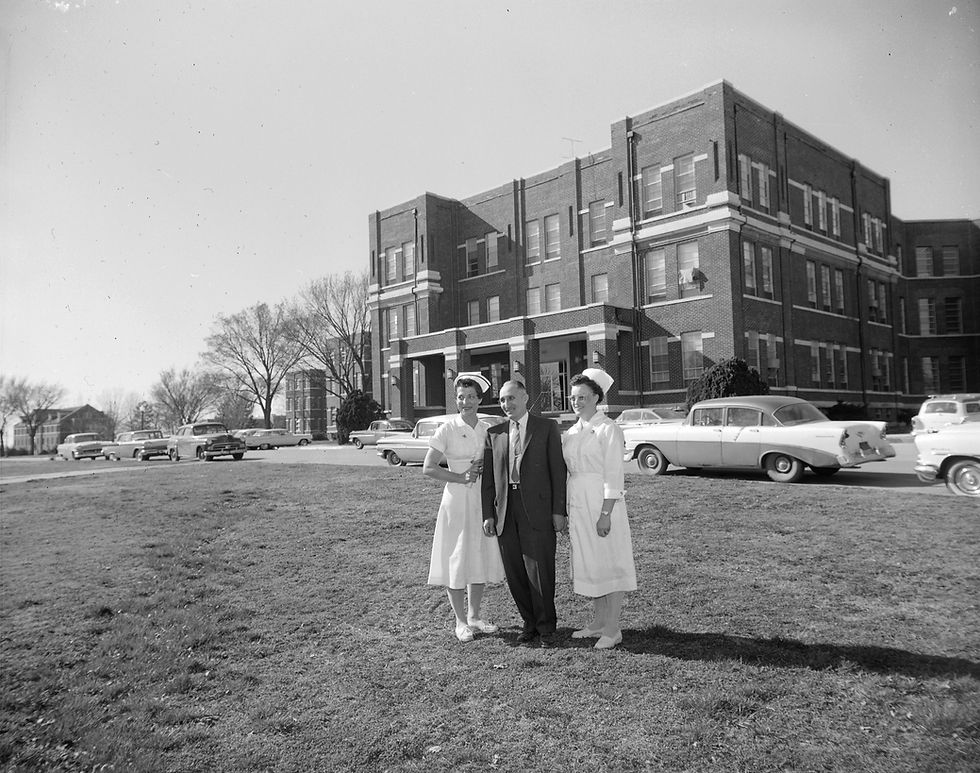
Like other Kirkbride institutions, State Hospital No. 3 initially sought to rehabilitate patients through a combination of psychotherapy and creative expression through art, music, and cooking. The hospital's administrators deviated from Kirkbride's plans in some ways—the facility was built to accommodate a maximum of 250 patients; when journalist Frank Peters visited the hospital in 1960, it housed over 2,000 "inmates."
However, Kirkbride's emphasis on the therapeutic power of creative expression was evident to Peters during that trip. "Walls throughout the hospital are hung with attractive products of the art therapy department," he wrote in an article for the Sunday News and Leader. Peters observed that some of the paintings seemed to "suggest brooding loneliness, and occasionally... deep disturbance seems transferred to the canvas."
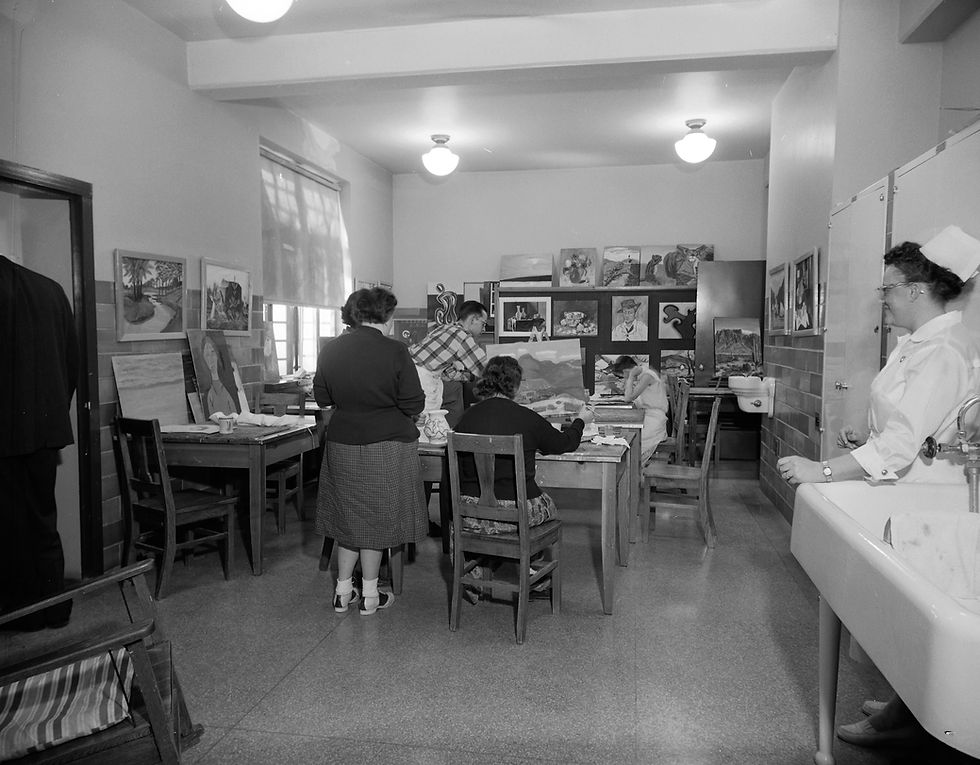
Were the Electric Pencil's drawings made as part of a similar art therapy program at State Hospital No. 3? If so, why were they made on ledger paper from the office of the hospital's treasurer? Could the answers to these questions be found in the content of the drawings themselves?
ECT and Other Puzzles
Upon first inspection, the Electric Pencil drawings do not resemble popular examples of outsider art from "mental patients," or even the works of other patients at State Hospital No. 3. There are no obvious traces of the "brooding loneliness" or "deep disturbance" observed by Peters in the products of the hospital's art therapy department. However, a closer examination of the drawings reveals unusual details which may put the viewer ill at ease. These include the caption for drawing 33, which seems to ask, "Why, doctor?" as well as the repetition of the letters "ECT" in drawings 94, 95, and 197.
Electric Pencil drawing 94. Published in The Drawings of the Electric Pencil. Electric Pencil drawing 95. Published in The Drawings of the Electric Pencil. Electric Pencil drawing 197. Published in The Drawings of the Electric Pencil.
According to Mayo Clinic, electroconvulsive therapy, often abbreviated as ECT, is a procedure during which electric currents are passed through the brain in order to deliberately induce a seizure. Electroconvulsive therapy is still used today to treat specific mental health conditions that do not respond to other therapies. Today, patients undergoing electroconvulsive therapy are anesthetized and given muscle relaxers to prevent injury as a small, controlled current moves through the brain. In the past, however, electroconvulsive therapy was performed using more powerful currents and without anesthesia, leading to pain, anxiety, and complications such as broken bones.
Could the letters "ECT" in the Electric Pencil drawings refer to electroconvulsive therapy? Did the artist make these drawings while waiting for or recovering from electroconvulsive therapy sessions? One detail that may support this theory can be found in drawing 95, where a cigar-shaped object appears beneath a portrait of a man in a fedora. Diamant theorized that this object is, in fact, a mouth gag, an instrument that was placed in the mouth during electroconvulsive therapy sessions to prevent patients from biting their tongues.
While experts struggled to identify the Electric Pencil's artist, a loose consensus did emerge as to when the artwork had been created. The artist's detailed representations of everyday objects, including women's clothing, seemed to suggest that he or she was taking inspiration from the world around him. Therefore, if one could date the fashion of the women in the drawings, one should be able to tell when the image itself was made.
Electric Pencil drawing 2. Published in The Drawings of the Electric Pencil. Electric Pencil drawing 47. Published in The Drawings of the Electric Pencil. Electric Pencil drawing 6. Published in The Drawings of the Electric Pencil. Electric Pencil drawing 151. Published in The Drawings of the Electric Pencil. Electric Pencil drawing 89. Published in The Drawings of the Electric Pencil.
In an email to Goodman quoted in The Electric Pencil: Drawings From Inside State Hospital No. 3, H. Kristina Haugland, associate curator of costume and textiles at the Philadelphia Museum of Art, contended: "The two images feature rather idiosyncratic dress that seems to be from the late nineteenth or early twentieth century but is not specifically datable to a particular time. The footwear, however, is very detailed... Judging from the shoes, and consistent with everything else in the images, I would say that the images may date to the first decade of the twentieth century."
Lyle Rexer, an art critic and curator who wrote the introduction to The Drawings of the Electric Pencil, arrived at a similar conclusion, dating the Electric Pencil's oeuvre to "around the year 1910" and suggesting that the artist had witnessed firsthand the American Civil War "as a child or young man." Rexer also dismissed any connection between the drawings and electroconvulsive therapy, a procedure which was not introduced until the 1930s.
If this were the case, then, how does one make sense of the artist's repeated use of the letters "ECT"? This and other questions surrounding the Electric Pencil would endure until, in 2011, the drawings were finally recognized by someone who knew the artist.
The Electric Pencil Revealed
Sisters Julie Phillips and Tudie Williams knew the Electric Pencil as Uncle Edward. After Phillips recognized her uncle's drawings in a January 2011 article in the Springfield News-Leader, she and Williams reached out to Diamant and told him about the man behind the Electric Pencil. His story was published in the News-Leader that July, and expanded upon in Goodman's introduction to The Electric Pencil: Drawings From Inside State Hospital No. 3.
James Edward Deeds, Jr., who went by Edward, was born in 1908. He was the oldest of five siblings, including Julie and Tudie's father, Clay. Deeds grew up on a family farm near Ozark, Missouri, and while he loved animals and the outdoors, he never took to farm work. Phillips reported that her father described Deeds as "very intelligent, loved the arts, was creative and didn't want to be on that farm," a trait she said "really irritated my grandfather."

According to Phillips, the incident that resulted in Deeds' institutionalization began in an argument with her father. "Edward probably just grabbed a hatchet like he was threatening him," said Phillips, "but he wouldn't have hurt him." Phillips and Williams believe that this sad affair provided Deeds' father with an excuse to have his son committed. Deeds, then 17 years old, attempted suicide when he learned that he was to be sent away.
Deeds was initially enrolled in the State School for the Feeble Minded in Marshall, Missouri. Then, in 1936, when the school deemed him "insane" and beyond their capabilities, he was moved to State Hospital No. 3 in Nevada, where he would remain for the next 37 years.
There, he spent his days drawing, working in the laundry—he still found farm work disagreeable—enjoying regular visits with his family (including his young nieces), reading, and receiving medical treatments which, according to Phillips and Williams, he may or may not have needed. When Deeds' hospital records were released to his nieces, they learned that he had undergone electroconvulsive therapy as part of his psychiatric program.
In the late 1930s, Deeds began drawing in what would come to be known as the Electric Pencil album. The curators of Hirschl & Adler Modern Galleries in New York speculated that the album functioned as a comfort object for Deeds, noting that the album "shows the wear of having been clutched unceasingly as a sort of palliative or even a talisman."

Deeds would continue drawing in the album for nearly three decades, until he was forced to stop by arthritis in his hands. He gave the album to his mother, Clara Maude Deeds, who then passed it along to her son, Clay. In 1969, Clay Deeds moved house and settled a dispute over pay with the movers by allowing them to take whatever they wanted from his attic. In doing so, he inadvertently gave away the Electric Pencil album. In 1970, the album ended up in a garbage heap on Seminole Street in Springfield, Missouri, where it was discovered by a fourteen-year-old boy.
In 1973, State Hospital No. 3 discharged Deeds, now in his sixties, declaring that he no longer posed a threat to society. He was moved to a nursing home in Christian County, Missouri. Deeds died of a heart attack in 1987 at the age of 78.
Electric Pencil drawing 64. Published in The Drawings of the Electric Pencil. Electric Pencil drawing 178. Published in The Drawings of the Electric Pencil.
"A World of Imagined Nostalgia"
Since the Electric Pencil artist was identified as Edward Deeds, his drawings have been exhibited in Springfield, Missouri, as well as in major metropolitan galleries in New York and Paris.
In 2016, Deeds' drawings were published once more in The Electric Pencil: Drawings From Inside State Hospital No. 3. The volume's introduction, written by Goodman, draws extensively from the biographical details provided by Deeds' nieces as well as commentary from experts across the art world. Notably, Deeds is explicitly named as the author of the work.
Before his identity was revealed, several experts were certain that the Electric Pencil's drawings depicted life in the late 19th or early 20th century. The truth is more complex. The drawings in the album are not straightforward representations of reality, but rather, portals into Deeds' imagined world. "Most art objects don't describe a whole world in detail," write artists Brian Eno and Bette A. in What Art Does: An Unfinished Theory. "Instead they come only as fragments of another world, and another way of being... They're pulled into our current reality as representations of another possible reality."
Goodman argues that, in the case of the Electric Pencil album, this "other reality" can be thought of as "a world of imagined nostalgia." He posits that "the fact that it doesn't really exist in any specific historical context is the point. Lady Smith, Lady York, Miss Winterstine, Miss Snider, Miss Fanny, and all the other men and women he names may somewhere exist in fashion, theater, local history, or literature... where they certainly do exist, and will always exist, is on the pages Deeds created. This is a world of imagination."
Electric Pencil drawing 52. Published in The Drawings of the Electric Pencil. Electric Pencil drawing 50. Published in The Drawings of the Electric Pencil. Electric Pencil drawing 155. Published in The Drawings of the Electric Pencil. Electric Pencil drawing 171. Published in The Drawings of the Electric Pencil. Electric Pencil drawing 185. Published in The Drawings of the Electric Pencil.
In 2012, Diamant began working with filmmakers Neville Bean and Robert Vandeweghe on an ill-fated documentary about Edward Deeds. Speaking with the Springfield News-Leader, Vandeweghe attested to the enduring power of the Electric Pencil drawings. "In a sense, it's the human spirit triumphing over really difficult times. I think our country could use a story like that."
What makes good art? Good art could be said to be that which speaks to the viewer, regardless of where it comes from or how it was made. Work by outsider artists like Deeds, however, is often only recognized by chance. "Such work can remain undiscovered," writes Rexer in the introduction to The Drawings of the Electric Pencil, "because it tends to be done in non-artistic situations, and since it often does not conform to widely held conventions of good taste or 'the beautiful,' it may be ignored, discarded, or destroyed."
Edward Deeds' drawings from State Hospital No. 3 remain poignant to this day—not because of the prestige of the artist, but because they speak to the spark of determination and creativity within the human spirit. Edward Deeds did not create the Electric Pencil album thinking that his drawings would one day be showcased across the world. He drew them simply because he wanted to.

If you enjoyed this article, please consider making a donation to the Preserving Ozarks History Endowment. Each contribution supports Local History & Genealogy's mission of preserving the history and culture of the Ozarks.
Want more local history news and stories delivered directly to your inbox? Sign up for Local History & Genealogy's newsletter and email announcements.
Special Thanks
Thank you to my comics professor, Cole Closser, for first introducing me to art brut and the Electric Pencil.
References
Dagen, Philippe. "La finesse de l'art brut." Le Monde, 3 January 2014.
Deeds, James Edward Jr. The Electric Pencil: Drawings From Inside State Hospital No. 3, Princeton Architectural Press, 2016.
The Drawings of the Electric Pencil, Electric Pencil Press, 2010.
"Edward Deeds - Talisman of the Ward." Hirschl & Adler.
Eno, Brian and Bette A. What Art Does: An Unfinished Theory, Faber & Faber, 2025.
Frederick, Pam. "More on the Electric Pencil." Tribeca Citizen, 7 June 2010.
Goodman, Richard. Introduction. The Electric Pencil: Drawings From Inside State Hospital No. 3, by James Edward Deeds Jr., Princeton Architectural Press, 2016, pp. 11-24.
Goodwin, Juliana. "Mystery artist from the Ozarks is recognized." Springfield News-Leader, 10 July 2011, pp. 1C; 3C.
———. "Mystery artist inspires film." Springfield News-Leader, 5 March 2012, pp. 6A-7A.
———. "Trash becomes treasure." Springfield News-Leader, 25 January 2011, pp. 5B; 8B.
Hocklander, Sony. "Seeking the Ozarks' unknown artist." Springfield News-Leader, 22 May 2007, pp. 1C-2C.
Mayo Clinic Staff. "Electroconvulsive therapy (ECT)." Mayo Clinic, 30 May 2024.
Peters, Frank. "Nevada: An institution Ozarkers once whispered about offers new hope for hundreds of mentally ill." Sunday News and Leader, 17 April 1960, pp. D-1; D-3; D-13.
Rexer, Lyle. Introduction. The Drawings of the Electric Pencil, Electric Pencil Press, 2010.