

Draw the Creepy Cryptids of the Ozarks

The Ozarks has a long and rich history of tall tales. Many of these yarns feature fantastical and frightening creatures that were said to inhabit the forests, caves, and waterways of the region. As these stories were passed from person to person, the creatures in them often changed shape, becoming stranger and more exaggerated over time. Today, we would refer to these legendary creatures as cryptids.
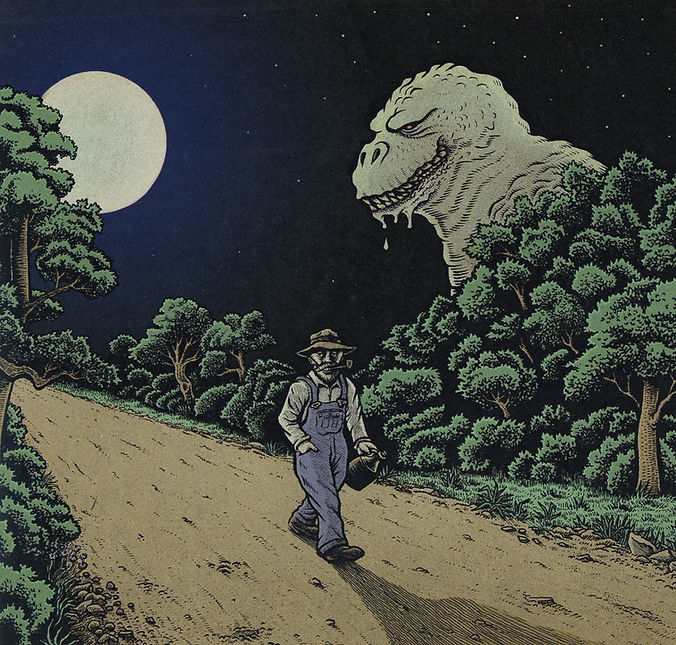
In We Always Lie to Strangers, folklorist Vance Randolph compiled accounts of many of these Ozarks cryptids. Since no authenticated photographs exist of these mythical beasts, depictions of them are shaped by the imagination of the artist.
At a recent meeting of Local History & Genealogy's Young Historians Club, attendees were given descriptions of Ozarks cryptids and asked to provide their artistic renditions. Now it's your turn. Read the description of each fearsome critter below and try your hand at drawing one yourself. Then, select "Reveal This Cryptid!" to learn more and see the drawings created by Young Historians Club attendees and by Library Graphic Designer Jay Young.
Picture it—this Ozarks cryptid...
is described as a large, all-white deer
has tree branches on its head rather than antlers
has leaves, flowers, or even fruit growing from the branches
emits a blue haze or smoke
Reveal the Cryptid!
The Snawfus
According to Vance Randolph's We Always Lie to Strangers, the snawfus of Ozarks folklore is "an albino deer with certain supernatural powers, puzzling to human beings, but not dangerous." In place of antlers, its head is adorned with the branches of dogwood, plum, or even apple trees, often bearing leaves, flowers, or fruit. The blue haze of the Ozark Mountains in winter is said to come from this ethereal cryptid.
Share Your Snawfus Artwork
Want to share your cryptid artwork with the Library? If you used the sketchpad above, be sure to save your drawing first. Then, select the button below to begin your submission. Don't forget to attach your drawing to the email before sending it!
A snawfus in a snowy clearing. Art by Jay Young. A "swafus" in a woodland setting. Art by a Young Historians Club attendee. A snawfus at dusk. Art by a Young Historians Club attendee. A snawfus in motion. Art by a Young Historians Club attendee.
Picture it—this Ozarks cryptid...
is covered in green scales
can grow to about twenty feet in length
has large tusks
has blade-like horns running along the length of its back
Reveal the Cryptid!
The Gowrow
Folklore cited by Randolph states that the gowrow, a ferocious cave-dwelling reptile, lived in rural Arkansas in the late 1800s. In the 1880s, a traveling salesman alleged that he encountered and killed a gowrow in a cave near Marshall, Arkansas. According to the salesman, the creature's lair was littered with bones.
Share Your Gowrow Artwork
Want to share your cryptid artwork with the Library? If you used the sketchpad above, be sure to save your drawing first. Then, select the button below to begin your submission. Don't forget to attach your drawing to the email before sending it!
A gowrow in its cave. Art by Jay Young. A gowrow in profile. Art by a Young Historians Club attendee. A gowrow with Super Mario for scale. Art by a Young Historians Club attendee. A "gorow" hanging from a cave ceiling. Art by a Young Historians Club attendee.
Picture it—this Ozarks cryptid...
is mostly aquatic, living in and around the White River
resembles a salamander
is as large as an alligator
occasionally capsizes boats
Reveal the Cryptid!
The Gollywog
Ever had your fishing tackle mysteriously disappear? According to Ozarks folklore, a gollywog may be to blame. Randolph's informants describe the gollywog as "a giant mudpuppy or water dog," both local names for salamanders. In addition to capsizing boats on the White River, the gollywog is said to enjoy destroying fishing tackle, "particularly trammel-nets and trotlines."
Share Your Gollywog Artwork
Want to share your cryptid artwork with the Library? If you used the sketchpad above, be sure to save your drawing first. Then, select the button below to begin your submission. Don't forget to attach your drawing to the email before sending it!
A gollywog causes a fishing boat to pitch. Art by Jay Young. A gollywog in profile. Art by a Young Historians Club attendee. A gollywog makes off with some tackle. Art by a Young Historians Club attendee. A gollywog lurks in the water. Art by a Young Historians Club attendee.
Picture it—this Ozarks cryptid...
is a type of hawk
has a wingspan of up to fifty feet
has a boat-sized beak
is covered in black feathers
Reveal the Cryptid!
The Giasticutus
This bird of prey takes Ozarks folklore aloft. Randolph records stories from West Plains of a bird with a fifty-foot wingspan known as the giasticutus. This enormous hawk was allegedly capable of carrying off full-grown cattle with ease. Smaller giasticuti were sometimes sighted elsewhere in the Ozarks.
Share Your Giasticutus Artwork
Want to share your cryptid artwork with the Library? If you used the sketchpad above, be sure to save your drawing first. Then, select the button below to begin your submission. Don't forget to attach your drawing to the email before sending it!
A giasticutus in flight. Art by Jay Young. A giasticutus carries off its prey. Art by a Young Historians Club attendee. The impressive wingspan of the giasticutus. Art by a Young Historians Club attendee. A top-down view of the giasticutus. Art by a Young Historians Club attendee.
Picture it—this Ozarks cryptid...
can stand upright like a person
has a long tail, staring eyes, and big teeth
has fur ranging in color from dark tan to black
is based on a real animal that was once common in the Ozarks
Reveal the Cryptid!
The Painter
The word "painter" is actually a regional pronunciation of "panther" in the Ozarks dialect. This animal is known by several other names, including cougar and mountain lion. These feline predators were once found throughout the Ozarks, and the earliest painter stories were probably inspired by real-life encounters with these animals. Stories of painters told of terrifying screams echoing through the woods or of the animals scratching at cabin doors. Over time, the painters in folklore began to take on more monstrous qualities, including the ability to walk on their hind legs and climb down chimneys.
Share Your Painter Artwork
Want to share your cryptid artwork with the Library? If you used the sketchpad above, be sure to save your drawing first. Then, select the button below to begin your submission. Don't forget to attach your drawing to the email before sending it!
A painter on the prowl. Art by Jay Young. A juvenile painter. Art by a Young Historians Club attendee. A painter enters a home. Art by an anonymous Library staffer. A painter in profile. Art by a Young Historians Club attendee.
If you enjoyed this article, please consider making a donation to the Preserving Ozarks History Endowment. Each contribution supports Local History & Genealogy's mission of preserving the history and culture of the Ozarks.
Want more local history news and stories delivered directly to your inbox? Sign up for Local History & Genealogy's newsletter and email announcements.
References
Randolph, Vance. We Always Lie to Strangers, Columbia University Press, 1951.