

George H. W. Bush and Marshfield's Fourth of July Parade

Updated: Oct 1
Editor's Note: This article was published concurrently with a Facebook post that stated that Marshfield's annual Fourth of July parade was the longest-running Independence Day celebration west of the Mississippi River. The actual date of the first Fourth of July parade is unknown, and as such, this claim is ahistorical and unverified. The text of the social media post, which contained this factual error, was written by the article's editor, Brandon Broughton, and not by its author, Michael Price.
Brandon Broughton
One of the most notable presidential visits to the Ozarks took place on July 4, 1991, when President George H. W. Bush led Marshfield's Fourth of July Parade. The parade marked Bush's seventh visit to the Ozarks, and his first as president.
The news first broke on June 17, when an administration official said that the president would arrive in Springfield on July 3 and attend a Fourth of July parade the following day. Missouri's Republican Party Chairman, Tom Fowler, cast doubt on the news: "Normally we would be notified well in advance of his visit. It would surprise me if he were coming to Springfield." Organizers of "An Old Fashioned Fourth of July," a celebration and parade in Springfield's Mid-Town neighborhood, had also not heard about the visit.
The White House confirmed and clarified the plans just two days later. President Bush would spend the evening of July 3 in Springfield, but rather than attending the Mid-Town parade on July 4, he would travel approximately twenty miles east to Marshfield's Fourth of July parade.
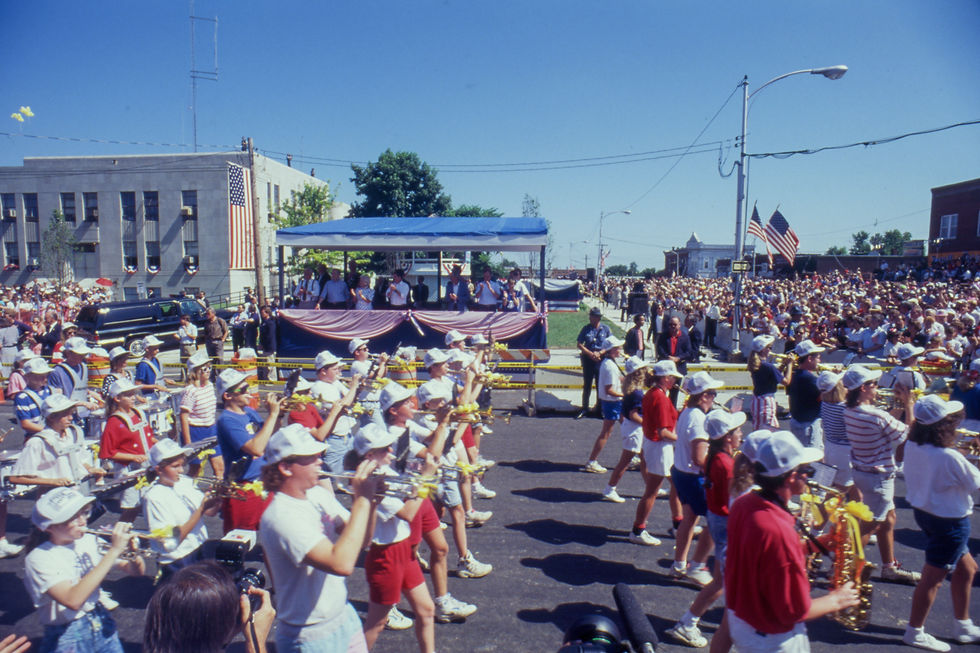
The Marshfield Fourth of July Parade
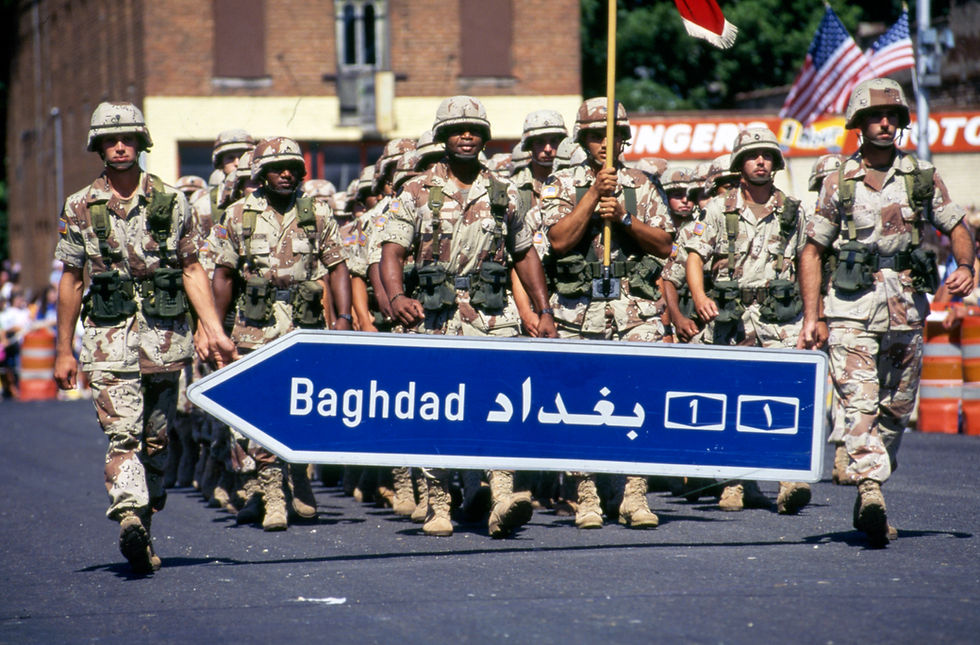
The 1991 Fourth of July celebrations held special significance as American troops were returning home from the Gulf War. As such, White House officials wanted to find a small town in the Midwest where President Bush could join in a triumphant celebration.
Marshfield was the perfect place for President Bush to celebrate the Fourth of July for multiple reasons. First, there were logistics: the Springfield Regional Airport could accommodate Air Force One, leaving only a short drive to Marshfield where the president and first lady could participate in one of the Ozarks' largest patriotic events. Then, there was the antiquity of the celebration. Marshfield's annual Fourth of July parade is among the oldest in Missouri, with some sources suggesting that the tradition began in 1880, just three months after most of the town was destroyed by a tornado.
Ultimately, Marshfield received a special recommendation. A spokesman for Governor John Ashcroft said "the governor has long known the July 4 celebration in Marshfield and he conveyed those sentiments to the White House when they considered a trip to Marshfield." Tony Hammond, executive director of the Republican State Committee, argued that "it's important for a president to get out in the real world and meet the people. They were looking for a town like Marshfield, and they found it."
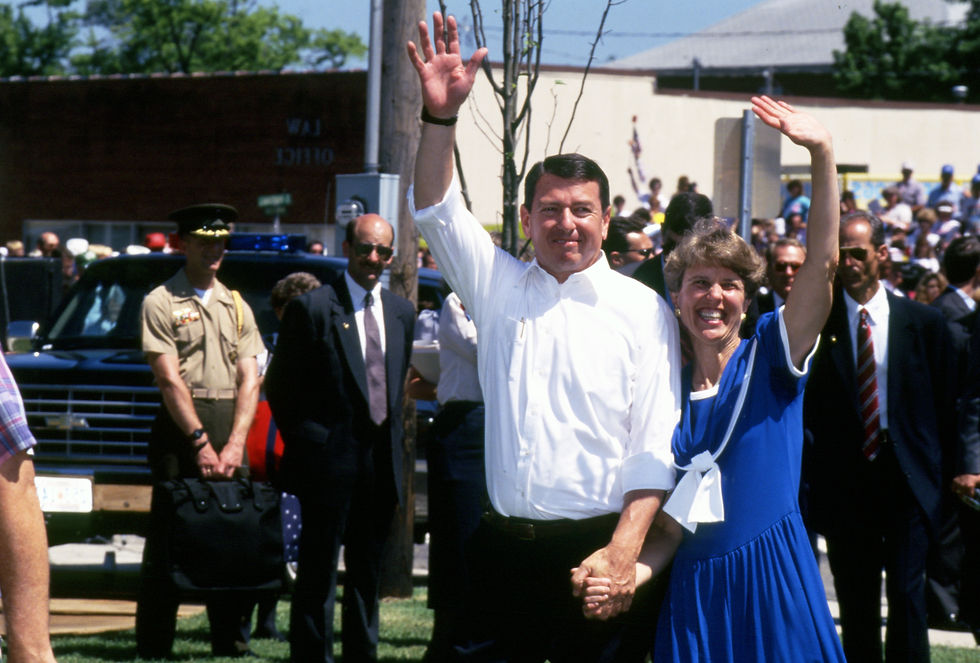
Amid the excitement, some Marshfield residents worried about the impact that the presidential visit would have on their community. The Fourth of July parade was routinely attended by about 5,000 people—already a sizable crowd for a town of 4,374—and everyone knew that President Bush's visit would draw in many more. Sherry Young, an employee of Peacemaker Bible Store on Marshfield's square, predicted: "I'm sure it will bring mass confusion, but it will be worth it." Connie Byrd, the owner of a portrait studio on the square, said, "It may bring such a large crowd that people won't be able to enjoy the celebration as much. It's real exciting, but naturally we in Marshfield are going to think about our comfort."
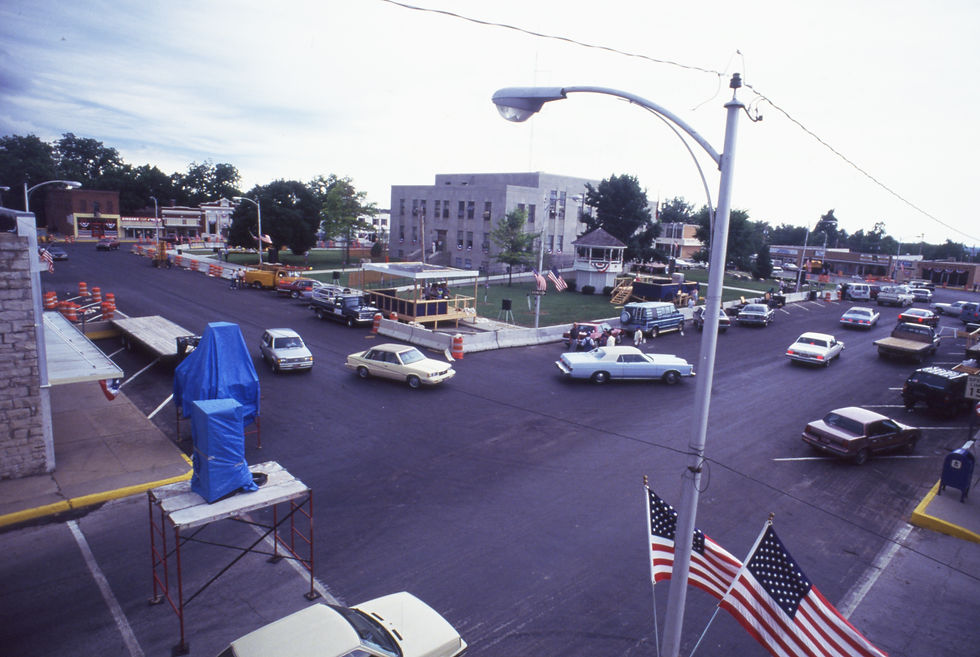
The national spotlight found Marshfield in a period of change. The square would serve as a patriotic symbol of small-town America, but some of its storefronts were empty. Elsewhere, the town was growing, with new businesses opening along Interstate 44. Marshfield was typical of many communities located along interstates: growth followed traffic patterns while downtown stores struggled. Nevertheless, locals loved Marshfield's small-town simplicity, and Jerry Van Wagner, executive director of the Marshfield Chamber of Commerce, said, "Marshfield will come into its own. Give us some time, but we'll come along."
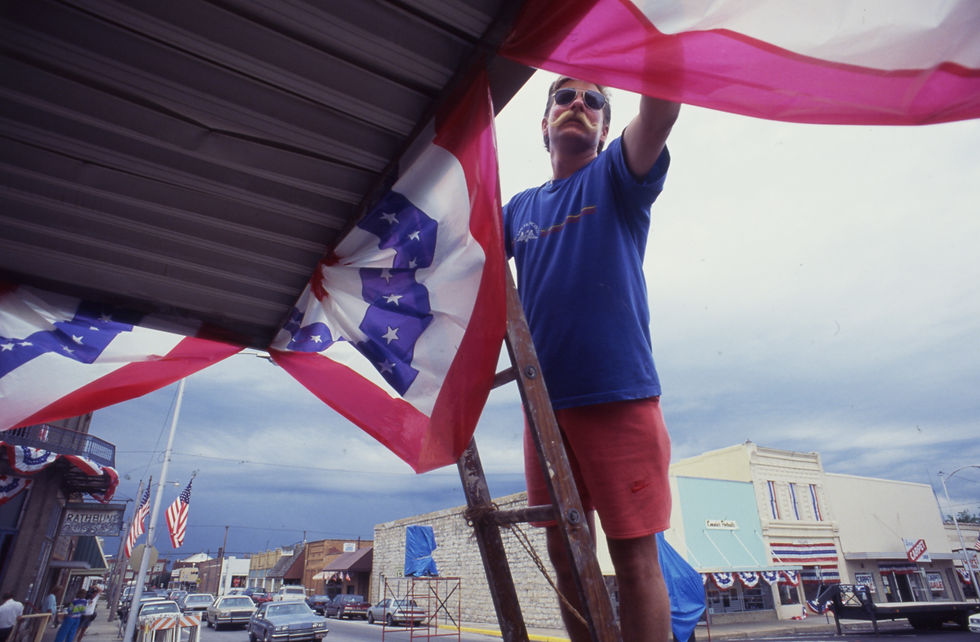
As Marshfield prepared for its largest Fourth of July celebration, another one was scaled back. President Bush usually attended a fireworks show at his family's vacation home in Kennebunkport, Maine. Since the president would not be there, an anonymous donor declined to spend over $10,000 to fund the Kennebunkport display.
The President Arrives in Springfield
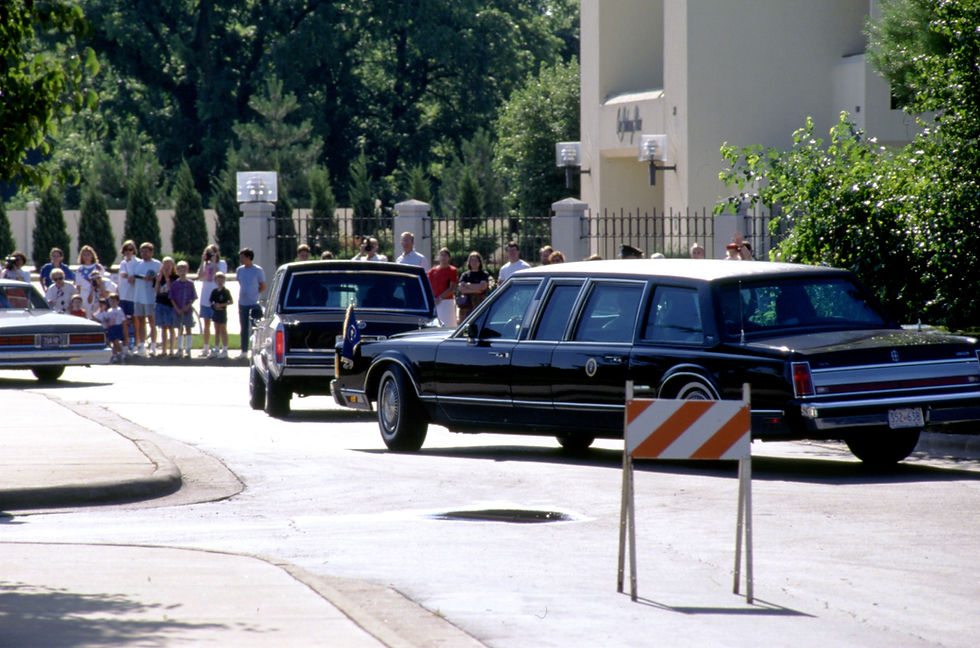
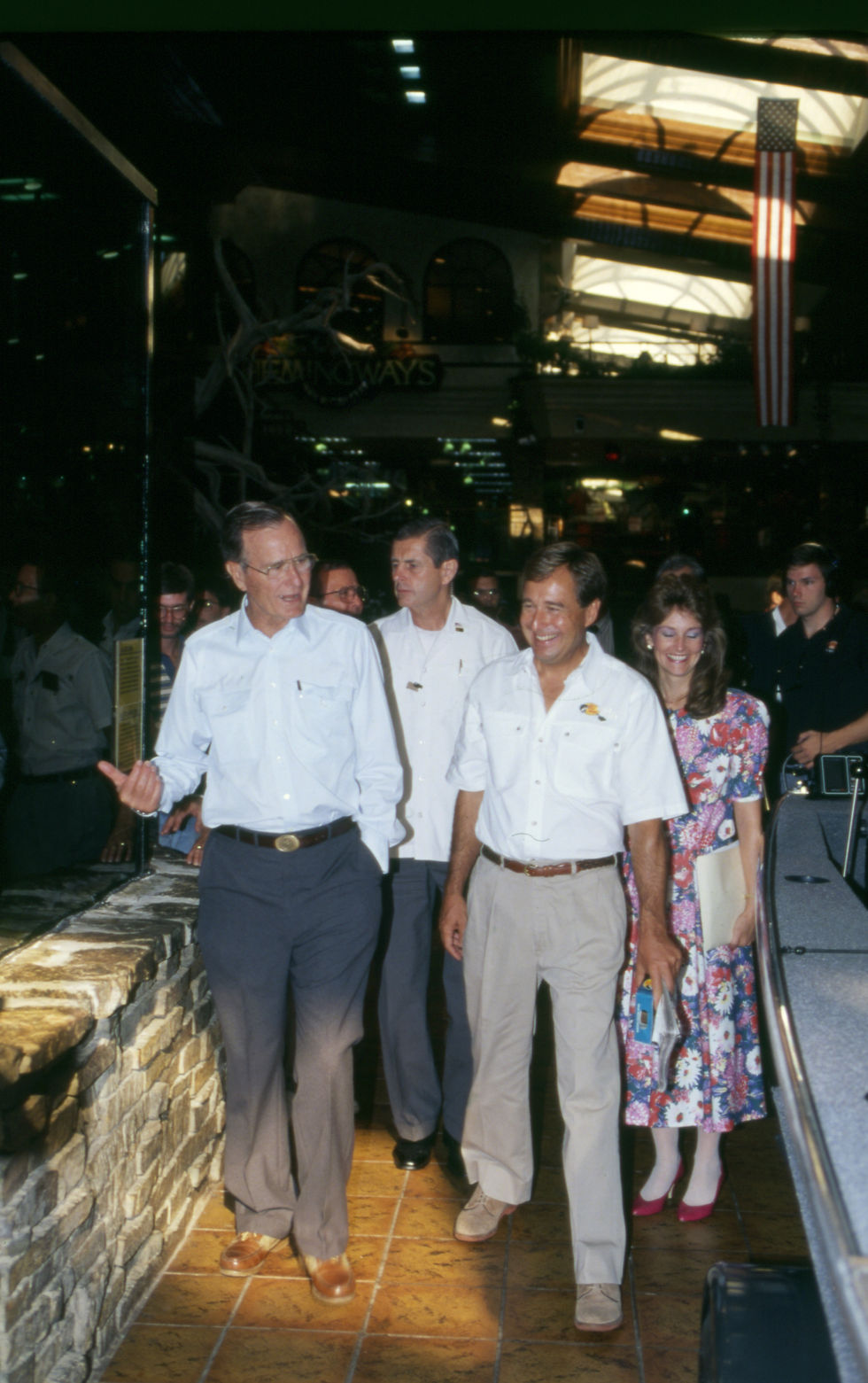
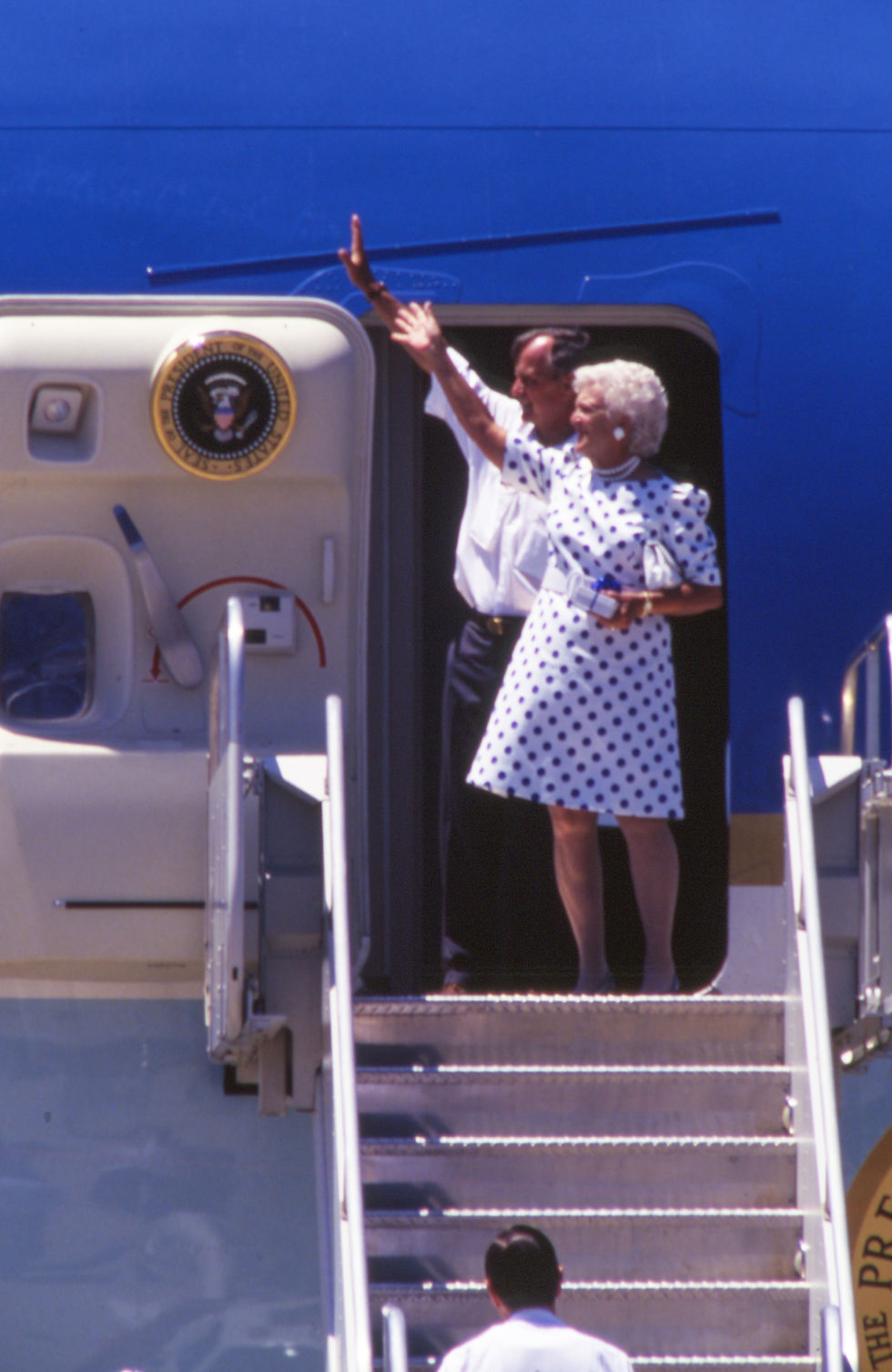
Air Force One landed at Springfield Regional Airport at 9:30pm on July 3. The president and the first lady were greeted by Governor Jay Ashcroft, Senator Christopher S. Bond, and Representative Mel Hancock, among other elected officials. An advocate for community volunteers, President Bush spoke with representatives from Hospice of Southwest Missouri but made no public remarks. About one hundred well-wishers watched as the presidential motorcade headed for University Plaza Hotel.
On the morning of July 4, President Bush enjoyed breakfast at Hemingway's Restaurant with Bass Pro Shops founder Johnny Morris. The president toured the store and purchased a Eureka brand tent before he and the first lady traveled to Marshfield for the day's festivities.
President Bush in Marshfield
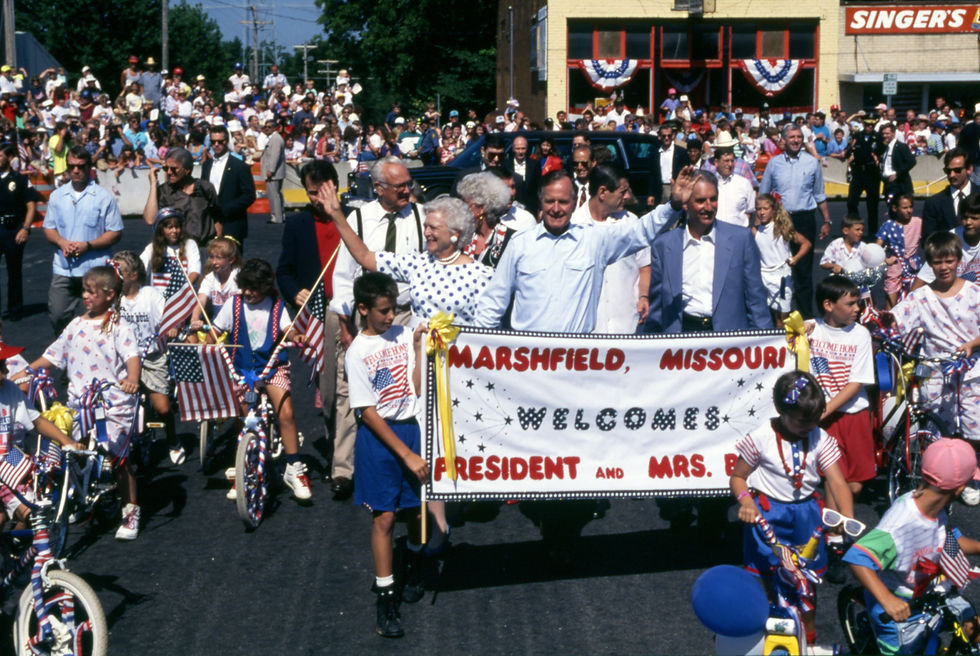
The presidential motorcade arrived in Marshfield just before 10am, minutes before the parade began. One of the greatest honors of the day went to six-year-old Christopher Carter, who was among fifteen Marshfield children chosen to escort the president around the square. Carter had this to say about his role in the big event: "My job is to drive my racing tractor. It's also my duty to look real good for the president and follow the rules and be nice. I hope he appreciates it."
After the parade, the president addressed the crowd from a gazebo on the courthouse lawn. President Bush's speech touched on many patriotic ideals which he believed were embodied by small towns like Marshfield. "These towns really do, as the governor said, cultivate the kinds of values that carried this country for over 200 years. Ones like liberty and ingenuity and independence," the president said. "And through it all—you could catch this in the parade, the spirit of the people that greeted us—through it all, faith in God. We are one nation under God and we'll never forget it."
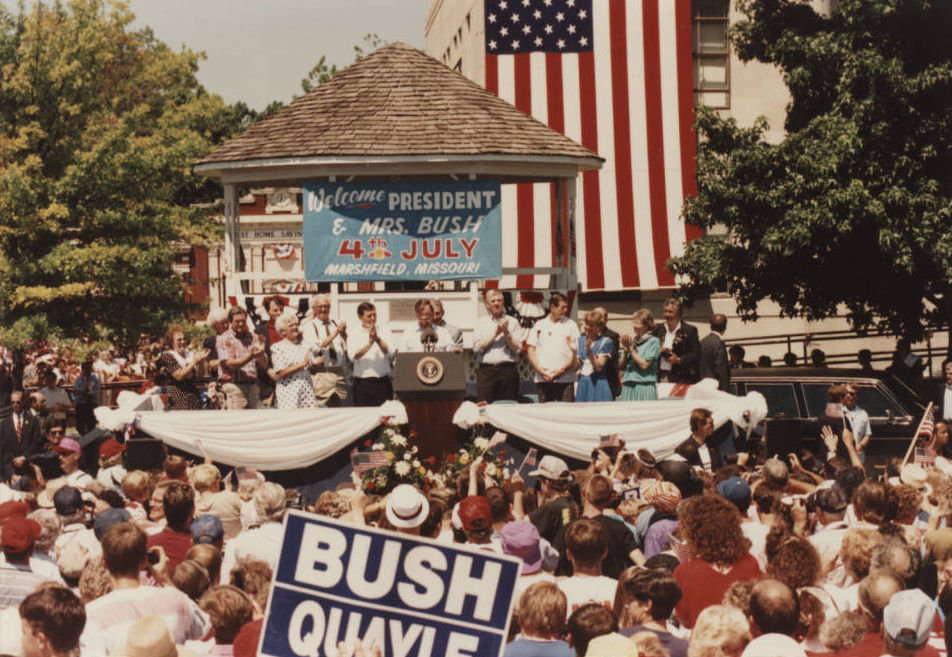
One of the reasons that President Bush had chosen to spend July 4 in Marshfield was the community's support for veterans. During his speech, the president offered a "special salute unto those who have served their country in uniform now and in days gone by, with particular emphasis on those men and women who served with such distinction in Desert Storm—what a job they did for our nation." He proclaimed that the veterans of Operation Desert Storm stood for American values and had "liberated a nation abroad, a tiny nation halfway around the world, and transformed a nation at home." Part of that transformation was the acknowledgement that not all of America's veterans had received an enthusiastic homecoming. "Desert Storm has at least brought the recognition and honor to our sons and daughters who served in Vietnam," the president said. "We finally have a chance to tell them thank you, and we're proud of them and welcome home—a little late, but welcome home."
President Bush also took the opportunity to address one of his most recent official acts: nominating Judge Clarence Thomas to the Supreme Court. Thomas had been recommended by Governor Ashcroft and Senator John Danforth, for whom Thomas had worked as an aide. "Clarence Thomas is a man of character and impeccable credentials, a model for all Americans," the president said. "You see he will be a great justice on the Supreme Court of the United States."
The confirmation process of Thomas was expected to be difficult, especially with supporters of abortion rights in the Senate. Recent Supreme Court decisions regarding abortion and concern about the appointment of Thomas to the court drove members of Planned Parenthood of Southwest Missouri and the National Organization for Women to organize a peaceful protest during the president's arrival at Springfield Regional Airport. Jane Boles, Planned Parenthood's public affairs coordinator, stated: "Our intent with this is to be extremely respectful. I think everyone in this group respects (Bush) and respects his right to have an opinion. We have our own opinion and we want him to respect that too."
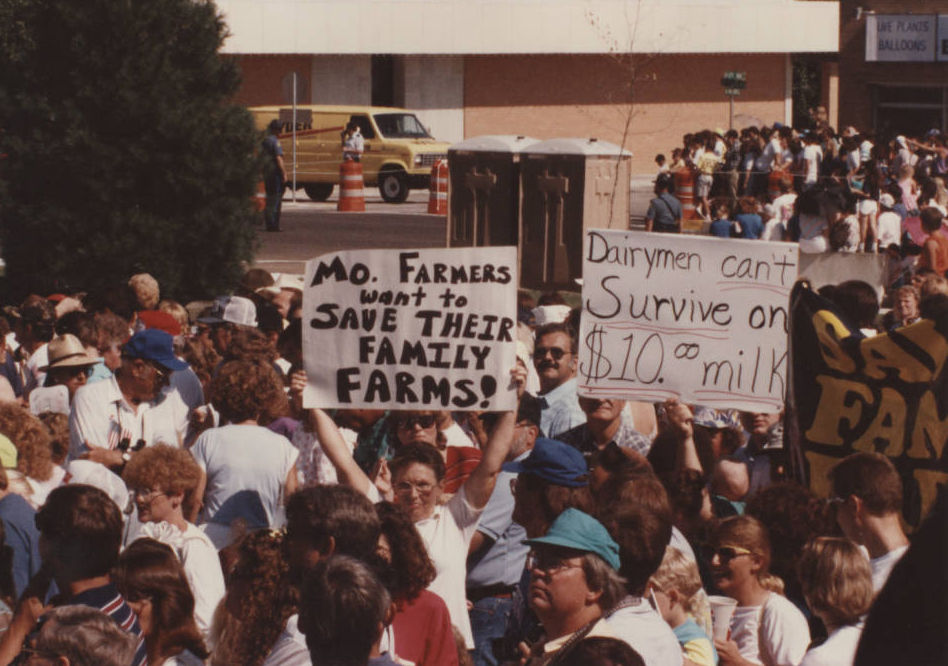
Protesters were also in attendance at the speech itself. About thirty members of Family Farmers of America held signs in a display as President Bush delivered his remarks on Marshfield's square. The farmers wanted the president to understand that an oversupply of milk had drastically reduced their income. Forecasts projected another bad year for dairy farmers in 1991, but President Bush remained reluctant to endorse a new farm bill.
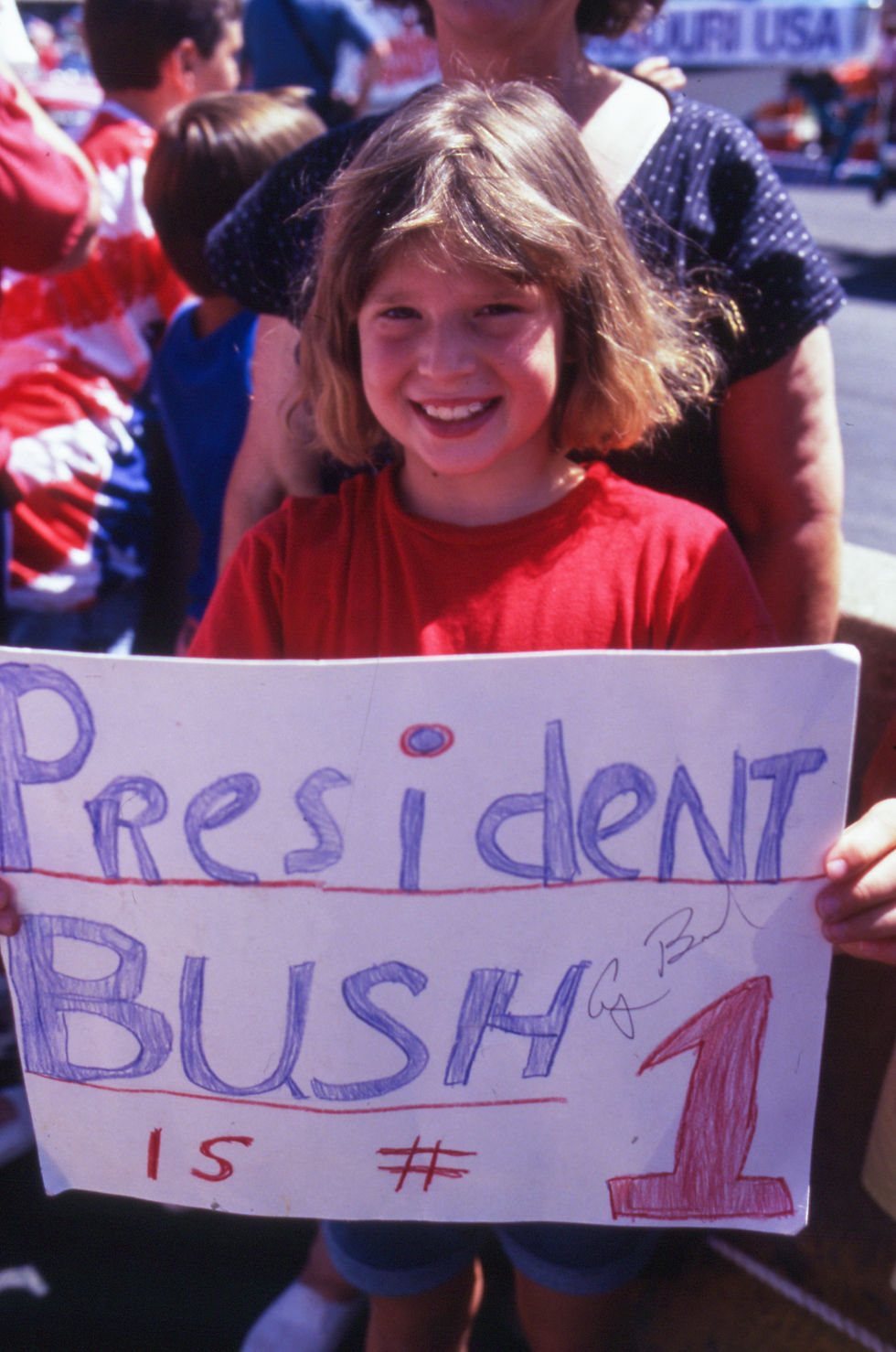
Even with protesters present, the atmosphere in Marshfield exceeded the expectations of White House officials. The community's display of patriotism and small town values was noted by President Bush from the moment he stepped onto the square: "Seeing the kids on the bikes here as we came into that parade, reminded us all of one thing—the importance of family, the importance of friends... Some people have called this the best little town on earth and I sure know why... By your hospitality you made Barbara and me feel very much at home and thank you so much for having us here today."
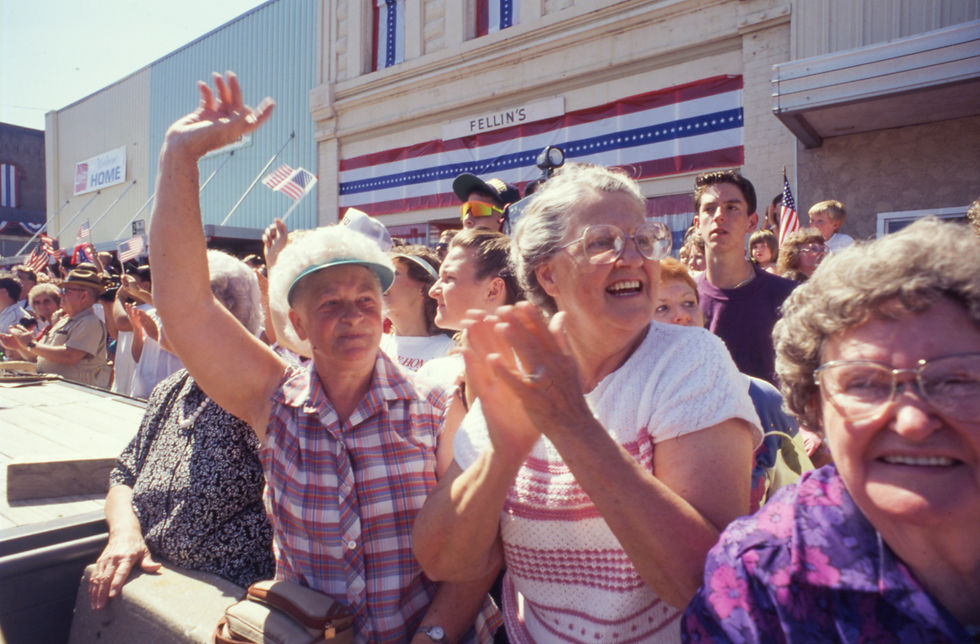
At 11:45 am, the celebration came to a close. The president and Mrs. Bush left Marshfield for Springfield Regional Airport, where they would depart for another parade in Grand Rapids, Michigan.
A Special Memory of World War II
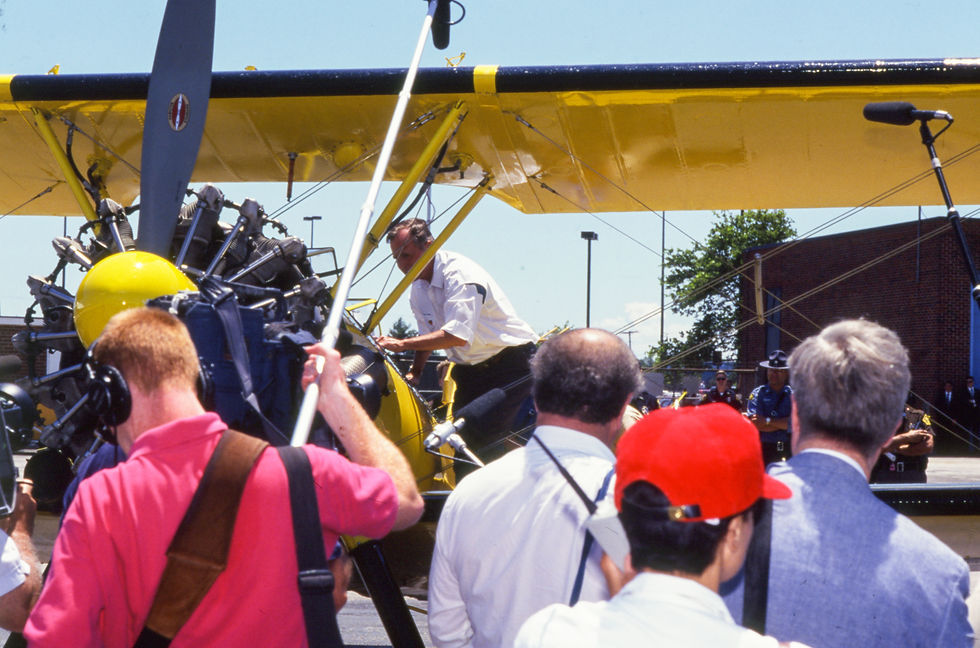
A reminder of President Bush's military service during World War II was waiting for him at the airport. Before leaving the Ozarks, Bush was reunited with a Stearman biplane that he flew during training in 1942. When the plane was purchased by Dave and Jody Corsaut in 1983, it was being used as a cropduster. Dave spent about 1,500 restoring it before he was contacted by the Naval Aviation Museum, which informed him that his plane was one of five "Bush trainers" still in existence. The museum provided a small plaque for the left of the cockpit that read: "This aircraft is certified as one flown by naval aviator, President George Bush."
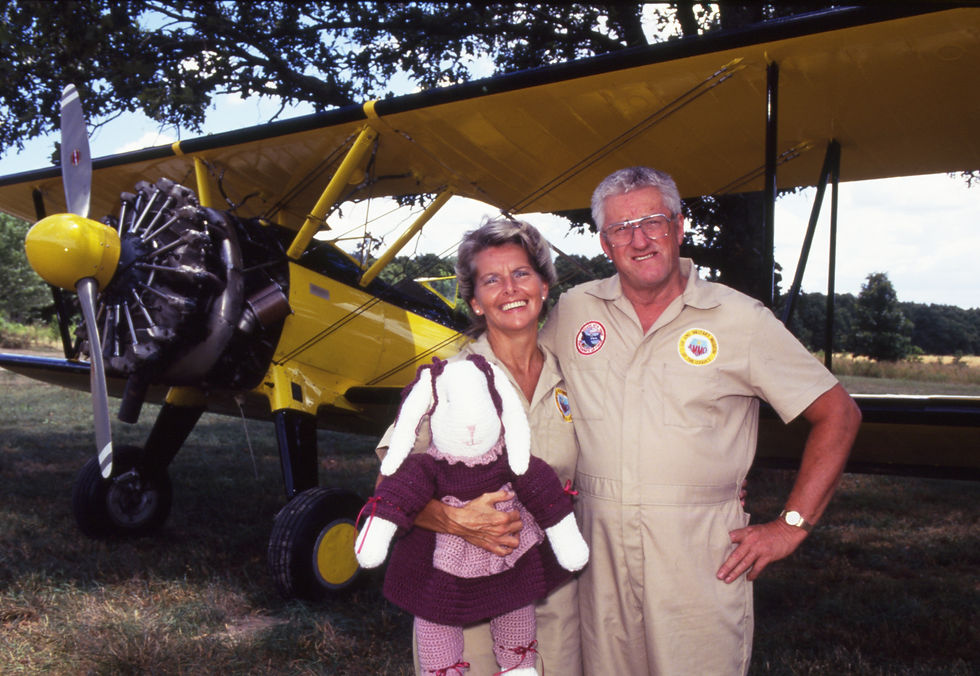
Due to his tight schedule, President Bush had only ten minutes with his old plane, during which he signed an autographed copy of his original training log. Calling Barbara over, he showed her the log and said, "see, I did fly this plane." Peering into the cockpit, the president gave the plane a pat. "It seems like such a long time ago," he remarked.
The Cleanup
An estimated 15,000 people had jammed into the Marshfield square, trying to catch a glimpse of the president and the first lady. Souvenir hunters were disappointed to learn that they could not purchase a piece of the reviewing stand and stage where the president had stood because county officials planned to use the structures for future events. Cleanup began July 5, with employees of Webster County and the Missouri Department of Highways and Transportation packing up 5,300 feet of orange netting, 300 barrel barricades, 100 concrete barricades, and much more. Mark Mikkelsen of the Highway Department reported that "it took a long time to put together, but it's coming down pretty smooth."
Throughout the festivities, Marshfield delivered exactly the kind of atmosphere that the White House was looking for, and that small-town image made national headlines. President Bush was touched by the response that he received during his visit, and based on his speech, the Springfield News-Leader concluded that he understood a phrase that they published every day: "'Tis a privilege to live in the Ozarks."
If you enjoyed this article, please consider making a donation to the Preserving Ozarks History Endowment. Each contribution supports Local History & Genealogy's mission of preserving the history and culture of the Ozarks.
Want more local history news and stories delivered directly to your inbox? Sign up for Local History & Genealogy's newsletter and email announcements.
Resources
"Bush's Visit Brings a Special July 4 to All." The News-Leader, 5 July 1991, p. 8A.
Clark, Christopher. "6-Year-Old's Big Day — He Leads the President, First Lady." The News-Leader, 5 July 1991, p. 2A.
———. "Advance Team to Arrive Thursday to Plan Bush's Holiday Visit." The News-Leader, 26 June 1991, p. 1B.
———. "Bush's Trip to Ozarks Confirmed." The News-Leader, 20 June 1991, pp. 1A; 6A.
———. "Flags, Signs Come Down as Marshfield Begins Cleanup." The News-Leader, 6 July 1991, p. 1B.
———. "Marshfield Faces Struggles at Crossroads." The News-Leader, 30 June 1991, p. 16A.
———. "Presidential Visit Has Drawbacks, Residents Say." The News-Leader, 20 June 1991, p. 6A.
Davis, Ron. "'Bush Trainer' Plane Owners to Meet Namesake." The News-Leader, 3 July 1991, p. 1A.
Edwards, Robert. "Bush Team Arrives Today for Visit Preparations." The News-Leader, 25 June 1991, p. 1B.
———. "Strike Up the Band!" The News-Leader, 4 July 1991, pp. 1A; 6A.
Keyes, Robert. "Abortion-Rights Group Greets Bush with Protests." The News-Leader, 4 July 1991, p. 6A.
"Marshfield Parade Becomes Presidential." The News-Leader (Weekend), 28 June 1991, p. 10.
McConnell, Kaitlyn. "Marshfield's Love of the Fourth of July." Ozarks Alive, 1 July 2016.
Oechsle, Kathy. "Bush Checks Over Plane He Trained in 50 Years Ago." The News-Leader, 5 July 1991, p. 9A.
"Ozarks Visit Snuffs Kennebunkport." The News-Leader, 29 June 1991, p. 1A.
"President Bush Plans to Celebrate July 4th with Ozarkers, Report Says." The News-Leader, 18 June 1991, p. 1A.
Woods, Willard. "Farmers to Offer Signs of Struggle for Bush's Viewing." The News-Leader, 2 July 1991, p. 5A.