

The Macks: A Union Family in the Ozarks

Updated: Apr 25
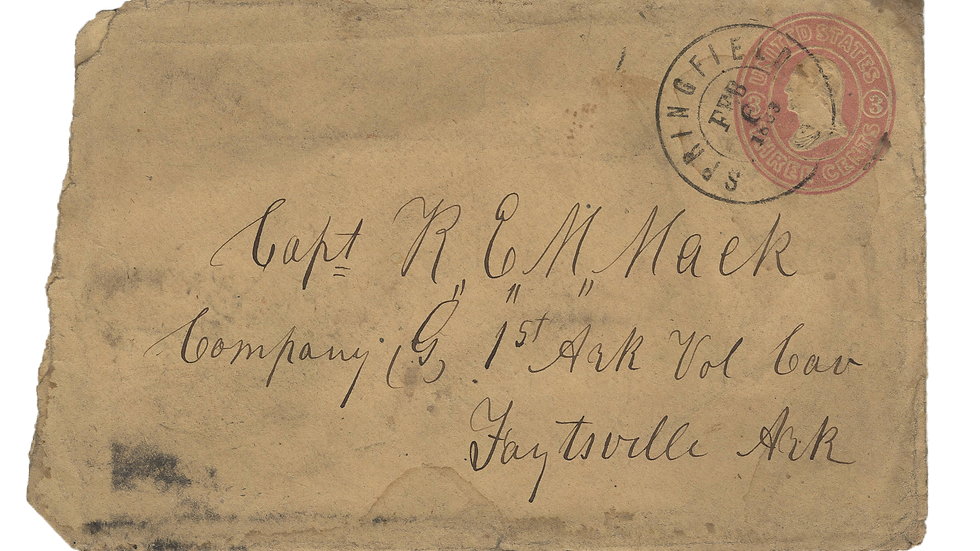
The Macks were one of Greene County's most prominent Civil War-era families. Their experiences as refugees, soldiers, and politicians are preserved in an extensive collection of letters written to relatives serving in the Union army. This correspondence provides a unique perspective on the Mack family's life in the Ozarks as the Civil War raged around them.
From Virginia to Missouri
Most of the letters in the collection were written by John A. Mack, who was born in Pittsylvania County, Virginia, on January 8, 1807. His family moved to Maury County, Tennessee, four years later, where John studied law when he turned 18. He married his wife, Sarah, on February 4, 1829, and moved his family to Wayne County, Tennessee, in 1837, where he held various county offices. The family came to Greene County, Missouri, in November 1852 and settled on a farm near Springfield.
A Community Divided
When the Civil War erupted in the spring of 1861, neighbors suddenly found themselves on opposite sides of a political divide. The bitterness even spread to the local schools. Two of John's sons, Rowan and Osman, were students at Springfield's Christian College. The instructor, Charles Carlton, and many of his students were secessionists. The Macks and a few of their friends were strong Unionists, a stance that made them unpopular among their classmates.
In 1861, a group of these Unionist students resolved to leave the school. At an agreed-upon time, they all stood up in class. R. P. Matthews, a friend of the Macks, spoke briefly for the groups. In his memoirs, Nine Months in the Infantry Service, Matthews recalls "silence, deep and profound as the grave" as he and the Mack brothers walked out of the Christian College, no longer its students.
Refugees and Soldiers
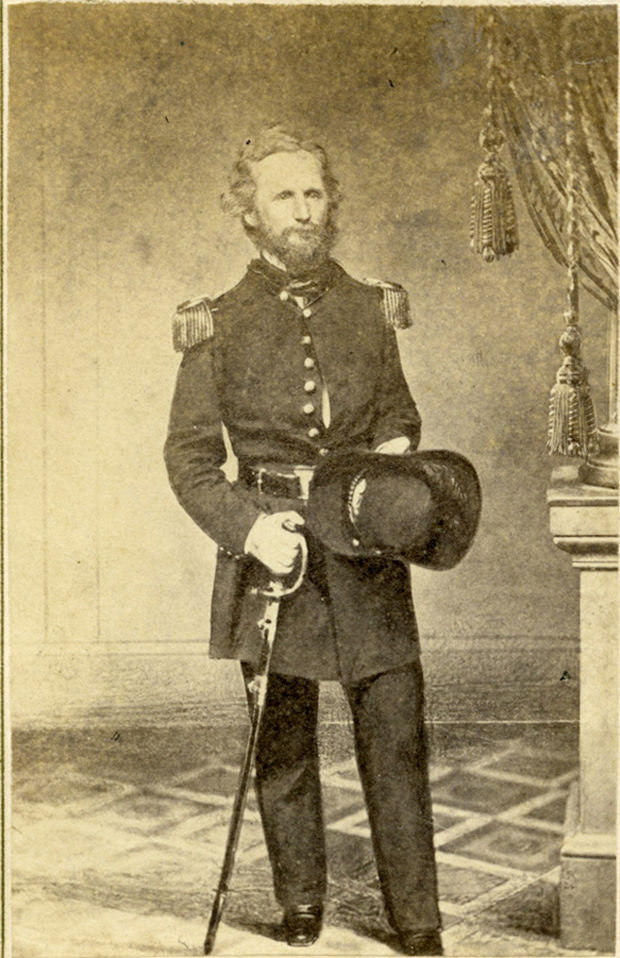
As pro-Southern forces gained strength in Missouri, Brigadier General Nathaniel Lyon authorized the formation of Home Guard companies to serve as local defense forces. John Mack was elected captain of the Greene and Christian County company, but the fortunes of war did not initially favor the Union cause. Following a Confederate victory at the Battle of Wilson's Creek on August 10, 1861, many Unionist families in Greene County fled north.
The Mack family was among a large group of refugees who followed the Union army on its retreat to Rolla. R. P. Matthews, who had been similarly displaced, was feeling especially sad about the course of events when he saw the Mack family along the road. John Mack cheered Matthews up, defiantly declaring, "darn 'em they haint got men enough in the world to divide this nation, and they aint going to do it." Matthews was heartened by these words and would later remember John as "quite a Philosopher, in his way."
John settled his family in Indianola, Iowa, where his son Marshall remained to care for them. Then, along with five of his sons—John Jr., Rowan, Robert, Osman, and William—John returned to Rolla, where they all joined the 6th Missouri Cavalry (U.S.) in late 1861.
A Family in Mourning
At 55 years old, John's health did not hold up to the rigors of soldiering. On March 7, 1862, Marshall wrote to his father, who was sick in camp:
You know you will never get well as long as you stay & probably have already contracted an uncurable disease you sertainly have forgotten the first principles of the teaching of the Bible to act as you are doing.
John and William both received medical discharges a few days after this letter was written, and they joined their family in Iowa.
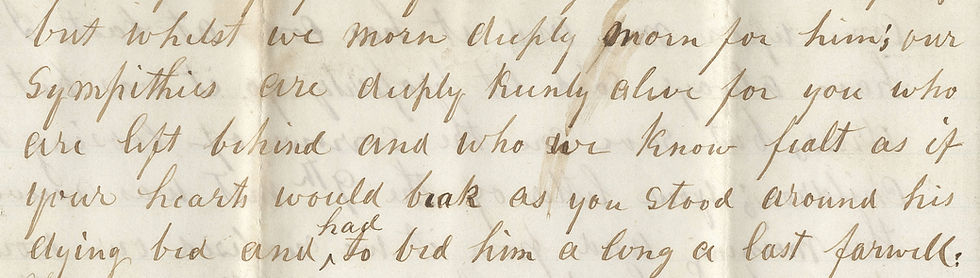
The Macks suffered a tragic loss when Osman died in Houston, Missouri, on April 6. A heartbroken John consoled John Jr., Rowan, and Robert, who remained with their regiment in the field:
Whilst we morn deeply for him; our sympathies are kenly alive for you who are left behind and who we know fealt as if your heart would brak as you stood around his dying bed and had to bid him a long a last farwell.
The Return to Springfield
Having rejoined his family in Iowa after his discharge, John soon made plans for a return to Missouri. In a letter sent to Rowan and Robert on April 12, John described how poor roads were delaying the journey:
It has been cloudy and raining or snowing almost ever since we got here... the roads at this time is almost impassible mud in many places to the hubs but if we can have dry wether the people say it will soon settle the roads we still think we will start about the 20th of this month.
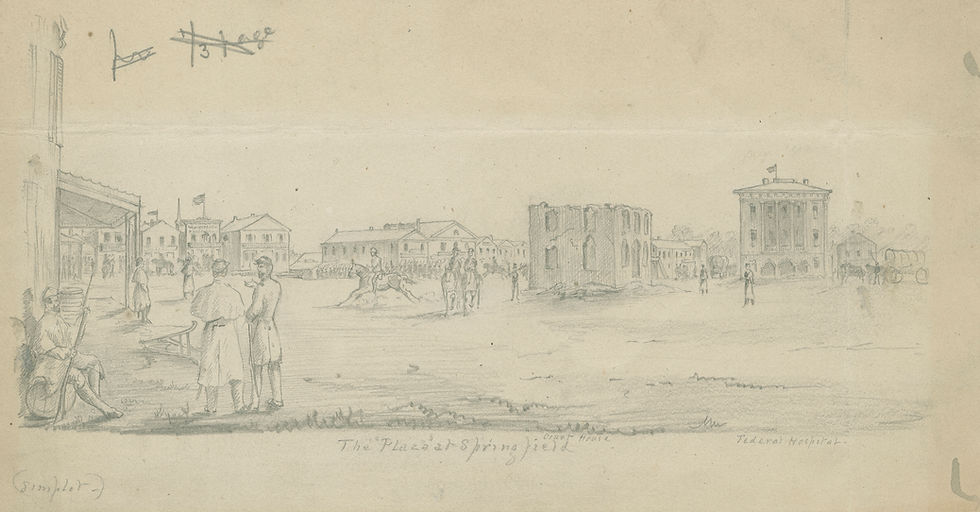
The journey to Springfield took the Mack family by wagon to Keokuk, Iowa, down the Mississippi River to St. Louis, and finally back on wagons to Springfield. By the summer of 1862, the Macks had returned to Greene County.
By then, Union forces had turned Springfield into a supply center for their armies operating in the Ozarks. The activity in Springfield presented Rowan and Robert with an opportunity to join a new regiment.
The 1st Arkansas Cavalry
In 1862, following the implementation of military conscription in Confederate Arkansas, many pro-Union families fled north to Missouri. Captain Marcus LaRue Harrison of the 36th Illinois Infantry was serving as quartermaster in Cassville, the first Union post that refugees from northwest Arkansas encountered in Missouri. After hearing their stories of oppression, Harrison realized that these displaced men could be loyal soldiers. He lobbied the War Department for permission to recruit a regiment among them. Permission was granted, and the 1st Arkansas Cavalry (U.S.) was organized at Springfield that summer.
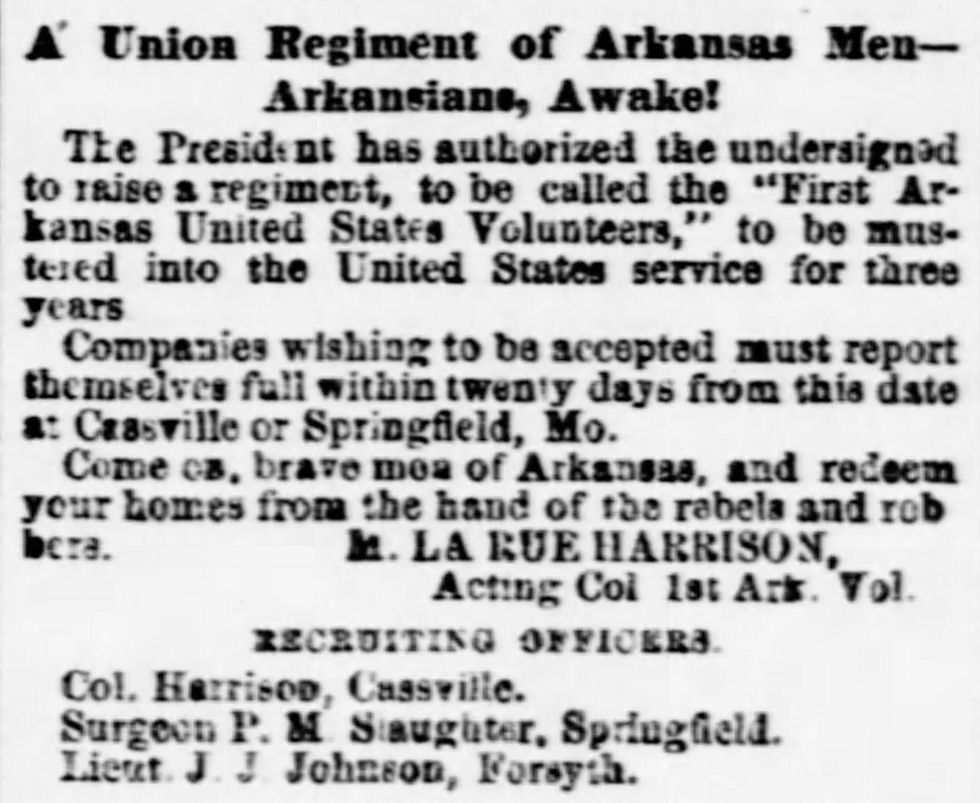
Rowan and Robert Mack seized the opportunities for promotion provided by this new regiment. Transferring from the 6th Missouri Cavalry, Rowan became the captain of Company G, while Robert served alongside him as a lieutenant. John Jr. remained with the 6th Missouri.
By the time the 1st Arkansas entered active service, most Confederate troops in the region had been transferred east of the Mississippi River. Small guerrilla bands sprang up in their absence. Mounted on the best horses, these bands preyed on civilians and attacked isolated Union outposts without warning. It was these units that the 1st Arkansas battled on a daily basis.
The regiment fought in the Battle of Prairie Grove in Arkansas on December 7, 1862, and spent most of the war operating between Fayetteville and Springfield. Due to a constant shortage of horses, troops were required to pursue well-mounted guerrillas on foot. Detachments were in the field daily, carrying mail, escorting wagons, and skirmishing with enemy forces. Soldiers performed this grueling duty with the knowledge that their families were in constant danger at home.
News From the Home Front
John maintained a steady correspondence with Rowan and Robert in which he reported on conditions in Greene County and expressed his thoughts on the war. One letter, sent February 4, 1863, reveals his significant disaffection with Union military policy. Just one month earlier, General John Marmaduke's command had attacked Springfield. The Union garrison held the city after hard fighting, but there were rumors that Governor Hamilton Gamble and General John Schofield planned to abandon Springfield and transfer the troops further east. John declared:
I believe that one third of our officers of the higher grade are trators one third are the imbodiment of corruption and with few exception the balance are ineficent and incapable of conducting the war to a quik suffull termination.
John next turned his wrath toward the army's inability to pay its soldiers. Although Congress had appropriated the money, men in the field were not receiving their pay.
You are both capable of judging for yourselves but in my judgment if the government don't pay off your redgt and do better then it has don I would resign and quit a service that was worse then usless.
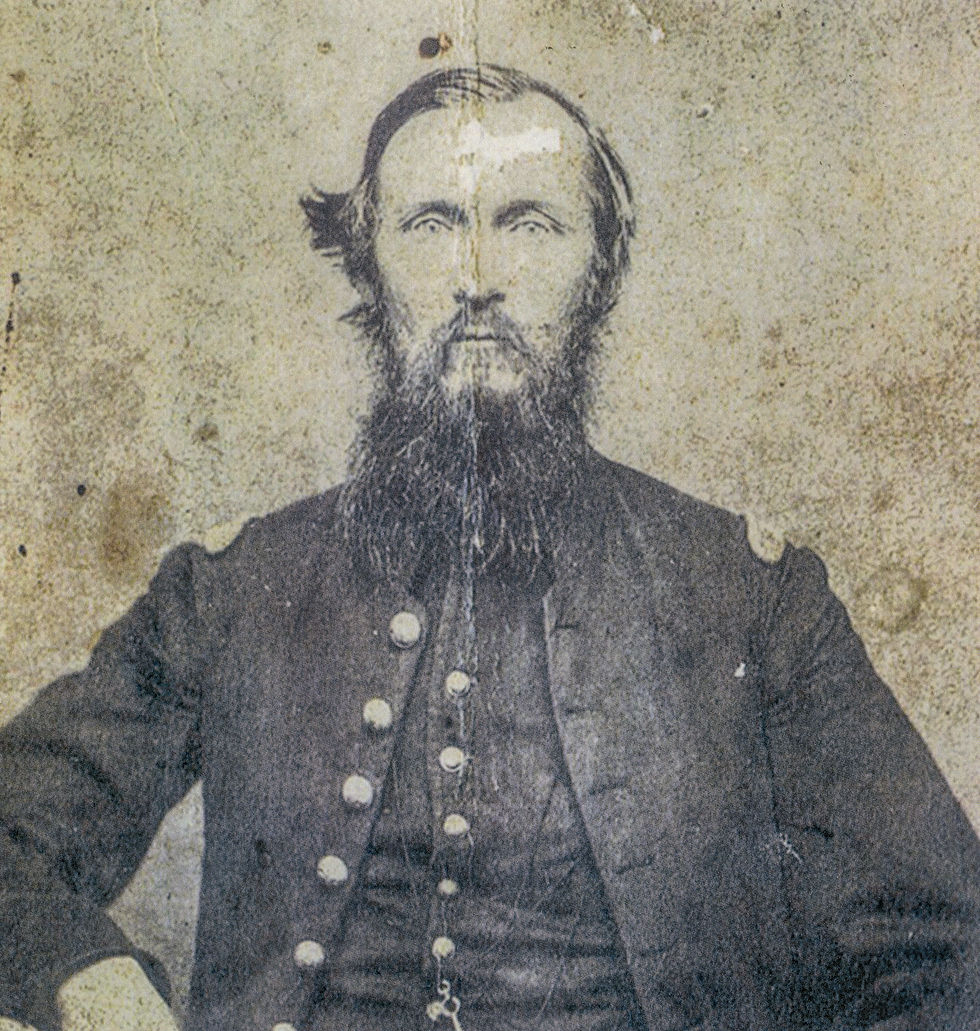
Rowan must have taken his father's advice, because when fourteen men from Companies E and G mutinied on February 19, Rowan was among the men arrested. Robert was identified as a witness, as was the regiment's commander, Colonel Harrison.
This mutiny was one of the most serious breakdowns in discipline in a regiment plagued with issues. However, in light of the harsh conditions in which the 1st Arkansas served, punishments were usually light when they were prosecuted. In Rowan's case, charges were not pursued.
Life Under Threat
On September 12, 1863, William Mack wrote to his brothers Rowan and Robert about danger back home.
There is some excitement here just now caused by the report that the rebels are agoing to leave and then they are coming to burn out the loyal citizen of this country... Several families past through Ozark for Dixie last week from up on James they made some threats of burning union houses.
Three days later, Carrie Childers, a family friend of the Macks who lived in Bolivar, wrote:
You may be ashured it is very bad. There is a man killed or a House razed evry night by the Rebels and the Union men from the country are coming in Town for protection though I think times will soon be better here The Secesh have There orders and are leaving.
These conditions locked the 1st Arkansas and guerrillas in a cycle of violence and retaliation, a fact Childers was aware of. She concludes:
I congratulate you on once more having the opurtunity of invading the Sacred Soil of Ark and presume the Rebels will have a hapy time while you are in Ark.
The Macks in Politics
One of the Civil War's most significant impacts in Missouri was the complete transformation of the state's political system. John Mack's entry into this divisive political climate culminated in him helping to reshape Missouri's political future.
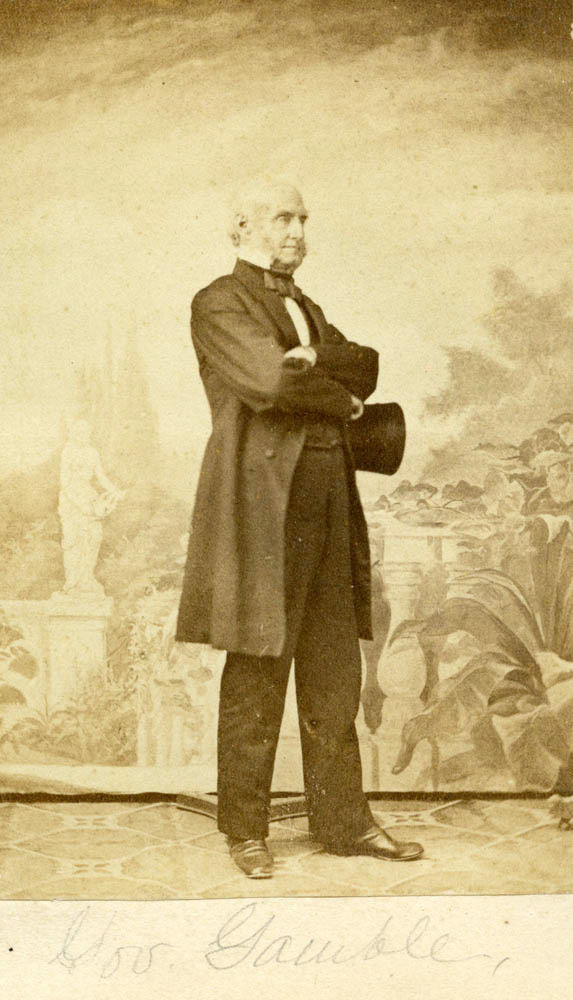
In 1861, General Lyon's army drove Missouri's pro-secessionist governor and legislature from power. They were replaced by a provisional government with Hamilton Gamble as governor. A moderate, Gamble's administration offered amnesty to ex-Confederates and supported the gradual emancipation of enslaved African Americans. Gamble's conciliatory measures angered Radical Republicans, such as the Macks, who called for immediate emancipation and the disenfranchisement of Confederates.
John was one of Greene County's most prominent Radicals when he ran for Probate and Common Pleas Judge in 1863. Before the election, John wrote:
Judge Elisha Headle [Headlee] is a Candidate for Probate Judge he well get all the Copperheads [a derogatory term for Democrats] of Course how we well make it I cannot say but I think if the voters turn out I will beat him hansomly.
John won the election and remained the Probate and Common Pleas Judge for Greene County until his death.
As guerrilla violence engulfed southwest Missouri in September 1863, Rowan and Robert received news of a Radical Convention from William, who wrote:
The radical convention that met in Jefferson City last week past of harmoniously and passed some pretty strong resolutions and if they (the radical party) only carries them out the Gamble dynasty will trimble in their boots.
Several horses and mules were stolen from the Mack family farm in the winter of 1864. John, who was Circuit Attorney at the time, blamed the theft on Democratic members of the grand jury, claiming that they stole his livestock in retaliation for charging Rebel sympathizers with treason. Although worried that this was part of a larger plot to restore pro-Confederates to power, John assured Rowan:
The Union men (Radicls) are waking up to the danger thay are in... We have a general election in November if I keep my health I shall be a candidate for some place I think most probably for a seat in the State Convention if so I shall take the stump and give these scoundrels fits if I have to fight for it.
John was not the only Mack involved in politics at this time. Rowan ran for a seat in the Arkansas Senate in March 1864. As the election drew near, John advised him:
Act with prudance and trust not in the least your enemies they are a set of umprescripted villins so keep you eyes open and ears also and guard with care your toungue.
Although Rowan lost the race, his candidacy illustrates that for the Macks, political participation was an extension of their military service.
The Macks in Battle
Like many parents who had sent their sons to war, John and Sarah Mack felt pride for his sons' heroism while also fearing for their safety. Learning that Rowan had been wounded in a skirmish, John warned in a letter sent October 26, 1863 that:
Bravery may run into rashness and we rather fear that success and escape from danger may beget in you what is called fool hardyness guard against that and while you act with bravery act with prudence your lives are of importance to your Country your family and yourselves the Country has few enough true Union men and while they battle for their Country they should take care of their lives and health.
In the same letter, John informed Rowan and Robert that their brother, John Jr. (still in the 6th Missouri Cavalry), had been injured on September 9 near Port Hudson, Louisiana.
He was shot through the cheeks with small rifle ball or buck shot the ball going in at the right side and out at the left knocking out several of his teeth and cutting the top of his toung but not hurting any bones he was back at New Orlen on the 13th Sept up and about and doing well the date of the letter.
Combat was not the only danger they faced, as Robert injured his hip when he fell from his horse in January 1863. Worried, John wrote:
I... was glad to know you were getting over it we fear it will be some time before you will get over it as a hurt in the hip joint is slow to get well take care of yourself and do not get out too fast it will be bad if you should be lamed for life.
Unfortunately, the injury forced Robert to resign his commission that November.
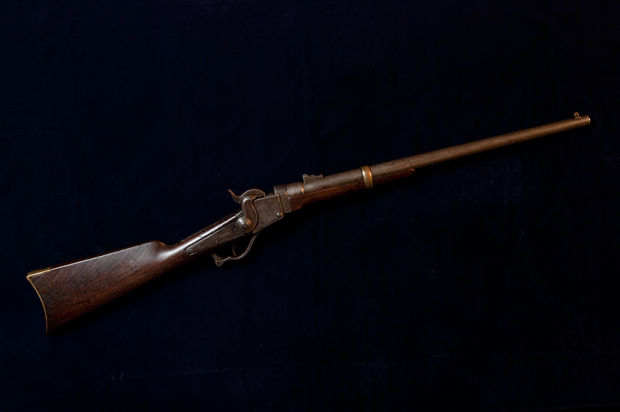
Responding to a letter from Rowan in February 1864, John wrote:
We... was glad to hear from you (as we always are) as we thought that the trip you were on with small no of men you had with you was rather a dangerous one... So far as to get back with whole skin at least but one thing let me say do not forget prudence and caution because you have thus far passed safly through so many dangers.
On May 28, 1864, Rowan was leading twenty-six men from his company on a march near Fayetteville when they were attacked by guerrillas. Tragically, Rowan and Sergeant Robert Scott were killed trying to lead their troopers out of the ambush. John Jr. narrowly avoided a similar fate when he was wounded in the head near Clinton, Arkansas, on August 26, 1864. He recovered and was mustered out of service at the end of the war.
Postwar Politics
Lincoln's reelection in 1864 ensured the North would pursue total victory. In Missouri, voters elected a new government and delegates for a constitutional convention. John Mack ran for a seat in the convention and defeated his opponent, R. L. Childers, by 58 votes.
The Mack family's political activity was part of a larger political transformation that the war brought to Greene County. In 1860, only 42 residents in the entire county voted for Lincoln, the Republican candidate for the presidency. Four years later, Republican candidates carried every township in Greene County, shocking local observers.
Radical Republican control at the state constitutional convention resulted in strong support for emancipation in Missouri. On January 11, 1865, delegates passed a resolution immediately freeing all slaves in Missouri. In February, the General Assembly ratified the 13th Amendment.
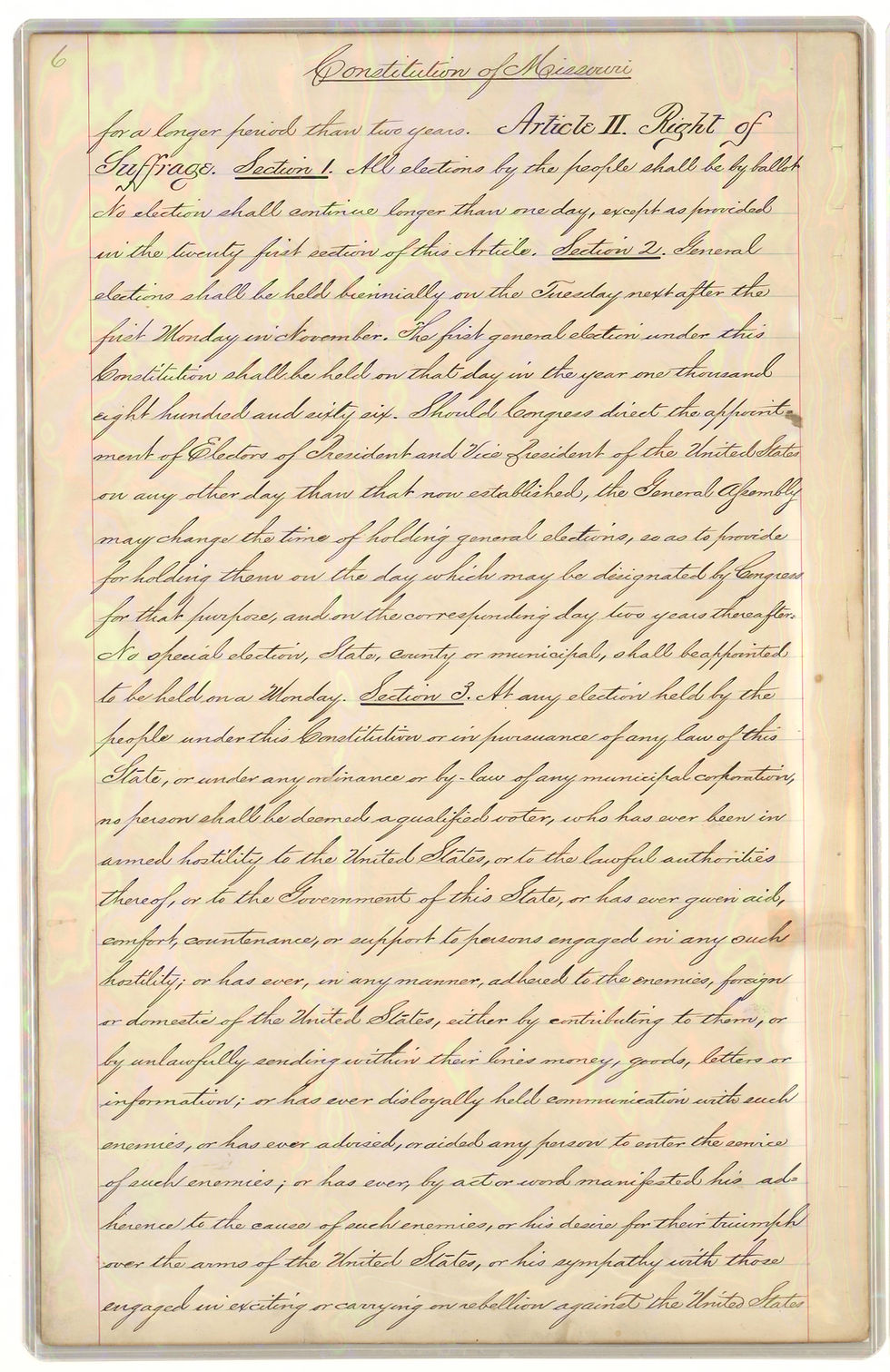
The convention's most controversial choice was one that sought to reshape Missouri's electorate. Determined to prevent ex-Confederates from returning to power, a committee led by Charles Drake drafted an Oath of Loyalty. Commonly known as the "Iron-Clad Oath," it identified 86 actions that were considered tantamount to supporting the rebellion. Any individual who sought to vote, hold office, practice law, or teach in Missouri was required to swear that they had not committed any of the acts outlined in the oath.
With the support of John Mack, the Iron-Clad Oath was enshrined in Article 2 of the 1865 Missouri Constitution. Mack's vote for the disenfranchisement of Confederate soldiers and anyone who had supported them was the result of his family's wartime suffering and their desire to only share citizenship with loyal Unionists. The Iron-Clad Oath was removed from the Missouri Constitution in 1870.
The Mack Family's Legacy
John A. Mack passed away in 1869, having left his mark on the history and politics of Missouri and the Ozarks.
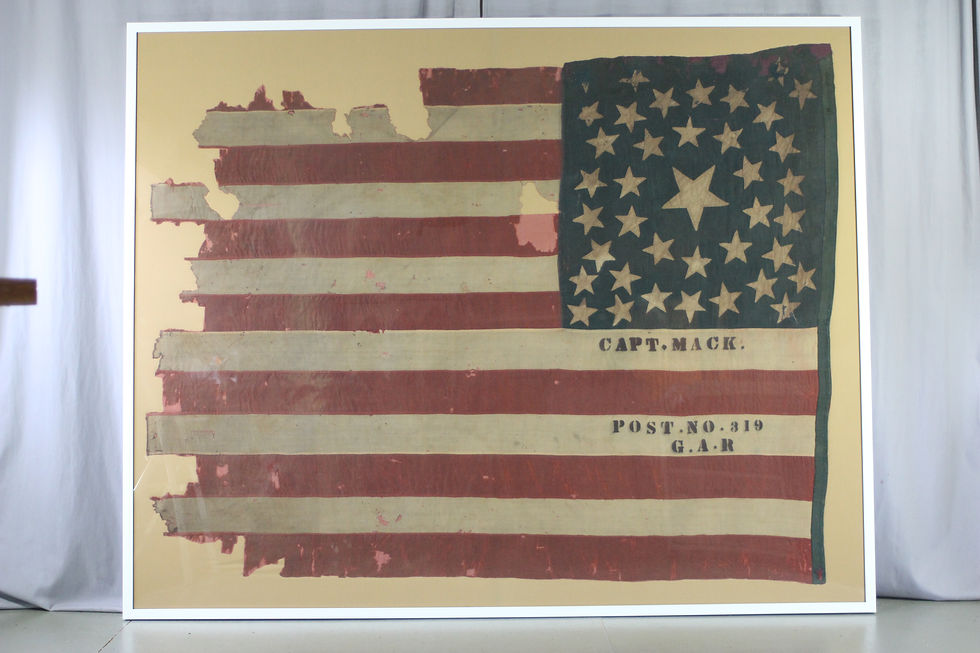
The sacrifice of his son, Rowan, was remembered by Union veterans who named a post of the Grand Army of the Republic (a Union veterans organization) in his honor. The Captain Mack Post 319 at Greene Ridge was organized in 1887. The recently restored "Mack flag," now in the collections of Wilson's Creek National Battlefield, symbolizes the dedication of the Mack family to the Union cause in southwest Missouri.
Other members of the immediate and extended Mack family remained active in Springfield after the Civil War, such as John Mack's first cousin once-removed, Judge J. W. D. F. "Alphabet" Mack, who was instrumental in erecting the Bailey Monument at the National Cemetery.
In 2025, the Springfield-Greene County Library received the Mack family letters through a generous donation from David Jones. These letters provide invaluable insight into the experiences of one Union family during the Civil War, documenting their struggles, losses, and ultimate triumphs in shaping Missouri's post-war future.
The letters can be viewed online in the Community & Conflict: The Impact of the Civil War in the Ozarks collection.
If you enjoyed this article, please consider making a donation to the Preserving Ozarks History Endowment. Each contribution supports Local History & Genealogy's mission of preserving the history and culture of the Ozarks.
Want more local history news and stories delivered directly to your inbox? Sign up for Local History & Genealogy's newsletter and email announcements.
Resources
Bologna, Giacomo. "Wilson's Creek Battlefield Unveils Historic Flags." Sunday News-Leader, 13 Nov. 2016, pp. A11; A13.
Childers, Carrie. "Carrie Childers Letter to Capt. Rowan E. M. Mack." 15 Sept. 1863, John A. Mack Collection.
Holcombe, R. I., editor. "From 1864 to the Close of the Civil War." History of Greene County, Missouri 1883, Perkins & Horne, 1883.
"In Memory." The Missouri Weekly Patriot, 16 Dec. 1869, p. 3.
Mack, John A. "John A. Mack Letter to Capt. Rowan E. M. Mack." 21 Mar. 1864, John A. Mack Collection.
———. "John A. Mack Letter to Capt. Rowan E. M. Mack and Brothers." 26 Oct. 1863, John A. Mack Collection.
———. "John A. Mack Letter to Capt. Rowan E. M. Mack and Robert B. Mack." 2 July 1863, John A. Mack Collection.
———. "John A. Mack Letter to Captain Rowan E. M. Mack." 4 Feb. 1863, John A. Mack Collection.
———. "John A. Mack Letter to Robert B. Mack, Rowan E. M. Mack, Moreau Mack, and Jack Mack." 12 Apr. 1862, John A. Mack Collection.
———. "John A. Mack Letter to Robert B., Rowan and Jack Mack." 16 Apr. 1862, John A. Mack Collection.
———. "John A. Mack Letter to Rowan E. M. Mack." 21 Feb. 1864, John A. Mack Collection.
Mack, Marshall H. "Marshall H. Mack Letter to Robert B. Mack and Brother." 7 Mar. 1862, John A. Mack Collection.
Mack, William L. "Lundy." "William L. 'Lundy' Mack Letter to His Brothers Rowan and Bob Mack." 12 Sept. 1863, John A. Mack Collection.
Matthews, R. P. Nine Months in the Infantry Service: The Civil War Journal of R.P. Matthews and Roster, the Phelps Regiment, Missouri Volunteers. Greene County Historical Society, 1999.
Tennessee, Marriages, 1796-1950. FamilySearch, database, entry for John A. Mack and Sarah Sophia Mack, 1829.
US, Civil War Service Records (CMSR) - Union - Arkansas, 1861-1865. Fold3, database, entry for Robert B. Mack (1st Arkansas Cavalry).
US, Civil War Service Records (CMSR) - Union - Missouri, 1861-1865. Fold3, database, entry for John A. Mack (6th Missouri Cavalry).
Further Reading
Parrish, William E. Turbulent Partnership: Missouri and the Union, 1861-1865. University of Missouri Press, 1963.
Price, Michael L. "A Continuous Story of Wrongs and Outrages": The First Arkansas Union Cavalry. 2004. Missouri State University.